|
Bridging Mississippi’s racial
divide with Town Meetings
By Diann McCabe
As we drove up Highway 61 to Memphis, memories of our life in Mississippi during the Town Meeting campaign in the late 70s came alive. At that time, my husband and I encountered mostly open hearted people in rural communities. We offered a meeting format to awaken citizen participation. The campaign shaped an awareness for us – of being in a special place at a special time. And because of the residue from the civil rights movement, our efforts seemed to hold potential for real change.
 We led town meetings, driving some 1,000 miles a week across Mississippi. The ideal meeting had a cross-section of people who came to brainstorm their vision for the community. They determined the blocks or contradictions standing in the way of their vision, and wrote proposals to address and remove them. One part of the meeting had participants writing a song and a story about the town and drawing a symbol of its past, present, and future. That bit always surprised everyone. We led town meetings, driving some 1,000 miles a week across Mississippi. The ideal meeting had a cross-section of people who came to brainstorm their vision for the community. They determined the blocks or contradictions standing in the way of their vision, and wrote proposals to address and remove them. One part of the meeting had participants writing a song and a story about the town and drawing a symbol of its past, present, and future. That bit always surprised everyone.
In the spring of 1977, the Institute of Cultural Affairs had initiated a Human Development Project (HDP) in Pace, Mississippi. It aimed to demonstrate the possibility of community engagement in a place whose potential was hidden. Pace was a town of 600. A railroad once ran through it but was removed during World War II. A white community lived on one side of the track and a black community on the other. After the launch of the HDP, we worked with both on a grant for a sewage system. Together we built a small playground with support from Xerox, started a pre-school and a laundromat, and held regular planning meetings.
Terry and I lived with a small staff in Memphis. He travelled holding town meetings while I held a day job but worked on town meetings in the evenings and weekends. Colleagues figured out how to shrink the town meeting format. We called together a cross-section of the community to demonstrate the process. We ended by asking, “Does this sound like something that would be good for your town?” The response was positive.
 We covered the rural delta of Mississippi with these three-hour evening town meetings. We brought in colleagues to help. In many towns, the “Delta Days” campaign saw blacks and whites meet under one roof for the first time, a little more than a decade after Freedom Summer. We covered the rural delta of Mississippi with these three-hour evening town meetings. We brought in colleagues to help. In many towns, the “Delta Days” campaign saw blacks and whites meet under one roof for the first time, a little more than a decade after Freedom Summer.
Places like Jonestown, Coahoma, Winstonville, Rolling Fork and others in the delta held memorial town meetings. These “beloved communities” made manifest the dream of civil rights. There was disparity in the fortunes of blacks and whites on the one hand and extreme kindness and grace of these poor rural communities on the other. Many were cut off from access to sewage systems, clean water, integrated schools, decent housing, good wages and jobs – resources that most of the nation took for granted.
People voiced these concerns at the town meetings but also imagined how to get at the root causes by working together.
Town Meeting: Mississippi 200
After Delta Days, ICA held a town meeting in every county in our region. We covered the entire geography of Mississippi and felt the rhythm of the land, the people and the history and sensed a new momentum.
Colleague Ruth Wilson came out of retirement in Chicago and moved to her family home outside Jackson, Mississippi. Governor Cliff Finch named her director of the office of Citizen Participation. Ruth contacted ICA staffer Frank Powell at Pace. They hatched a campaign called Town Meeting: Mississippi 200, sanctioned by the governor’s office. With the slogan “Mississippi is Leading the Way”, 200 town meetings were held during 1978-79. The places ranged from Ruth’s rural community called Crossroads to the more developed town of Tupelo in northeast Mississippi.
The governor’s sponsorship put our work in a new light. We travelled in teams of four, two to a car. We had confidence. We knew what we were doing was radical, powerful and needed. Because of that, we were always able to set up a town meeting – just a week after the first visit.
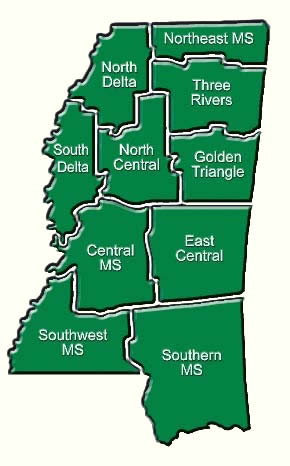
We approached the geography through the 10 Planning and Development Districts, holding 20 to 22 town meetings, women’s forums or youth forums in each district. Each district had different cultures. We had to be open to the geography and mindsets before us.
We plotted rural communities on a map. On arriving in a targeted community, if we had no contacts, we would walk into a store and after exchanging pleasantries ask, “Who in this town really cares about the town and its future?” An answer always came. We found the person’s home or business and talked about the town and the Town Meeting: Mississippi 200 program. We asked the person to call together a cross section of the community to plan for a town meeting.
Some town meetings had 10 participants, some had 200. The highlight of the evening was the plenary when the document they had helped produce was handed out like a little miracle to each participant. It held their hopes and dreams, challenges and proposals, and the song, story and symbol of their town.
We carried ditto machines and reams of paper in our trunks to produce the documents or relied on resources of the town. After the documents were distributed, we held a reflection. We asked a series of questions: What do you remember doing tonight? What surprised you about this process? What would you tell someone we did tonight? How are you or this community different now? What is next?
People got inspired. They did follow-up activities like the Mize watermelon festival. They solved issues that had stalled the building of a bridge over the Mississippi in Natchez. There was a light in their eyes and a lift in their step. It was rich and meaningful. We felt we were truly “leading the way” to a better world.
These town meetings worked because we expected them to work in bringing people together, and because we had refined the method to move quickly to engage everyone in the room. No one made speeches; everyone was asked for his or her response. At the meetings, held in small churches or large community centres, both blacks and whites talked together about their town and their future. They began to see each other in a new light, realizing that those gathered did care and could work together for the same vision. So much more could be said about being in an amazing place during amazing times.
Returning after 33 years
On our return to Mississippi last August, 33 years later, we drove up Highway 61 with Bob Dylan’s music echoing in our ears. We remembered the hundreds of miles we had travelled up that road from the edge of the delta to Memphis and back.
We stopped at Natchez for a tour of the African American Museum housed in a post office built in the 1930s. A white man and a black veteran of Afghanistan hosted our tour. There were black family photos of slaves and former slaves, stamps from France, African masks and books by local writers Richard Wright, Lorraine Hansbery and others. Natchez, the site of Forks of the Road, was the second-largest slave auction site in the US. But it integrated and passed civil rights legislation “better” than any town in the state, said our B&B host. He claimed that Mr Byrne, who was mayor when we held the town meeting there, was “very progressive about racial justice, and was ahead of his time.”
We left Natchez feeling at home with the people and history there.
We took Highway 8 towards Pace. We remembered how to get there. As we neared, we saw a beautiful freshly painted wooden sign: Welcome to Pace: Small Town with a Big Future. Below the words was the Delta Pace grid. Both slogan and grid originated in the 1977 Pace HDP.
Inside the town we saw two sections of apartments, one funded federally and one by a Delta foundation. Further in, a grass covered lot where the ICA house once stood. The faded Delta Pace Laundromat sign could still be read over a boarded up building. A police officer told us that although the elementary school had been boarded up and Pace children were now bused to Rosedale, “Pace was on the move.”
There was evidence of his claims. The public space was mowed and cared for. There were two parks: one with a mural and a sign dedicated to “Booker Woodruff” for “his love of community”, and another with a gazebo and two picnic tables. A Chinese man came out of the old “Lim” convenience store to stare. We felt a strange sense of familiarity and alienation.
We went on to Memphis, where we had lived less than 10 years after King’s assassination, when the downtown and Beale Street had been boarded up and the Mississippi flowed by in silence.
Now a vibrancy filled the downtown and Beale Street – art, music and a rich sense of heritage and pride. So unlike 1976. We enjoyed the music, beautiful views of the river, museums, food and crowds during our two days there.
We visited the house on Peabody Avenue where we lived during 1976-79 and staged Delta Days, and supported the county town meeting coverage and Town Meeting: Mississippi 200.
The house once held 20 ICA residential staff. It was now an office for Church Health. We met Ann and Marvin who told us the story of Church Health. Dr. Scott Morris, a Methodist minister and physician, had started it to “carry out the gospel – caring for the body and the soul.” Church Health is the largest faith-based organization providing health care for the working poor. All done in the space where we slept, ate, sang, planned, laughed and cried more than three decades ago.
Ann and Marvin asked us to tell them what we did when we lived on Peabody Ave. They seemed to understand the intent of the town meetings and human development project. Marvin said he could see how ICA’s presence in the house had opened the door to the work they are doing now.
We left with gratitude for the chance to see this geography again. We used to say we wanted our lives to make a difference. Perhaps that wish is self-serving. But there is a genuine desire in each of us to give of our lives. We know that the decades-old problems are not only present but have intensified. Yet seeing this landscape and meeting these people along Highway 61 reminds me that the past is a part of the present and a part of each of us. Our hope is in creating the future in the manner we are called to do.
Terry and Diann McCabe lived and worked in Atlanta, Memphis, Pace and Jackson, all in Mississippi, US, and in Bontoa village, Indonesia, with the ICA during 1973-82. They now teach at Texas State University in San Marcos, Texas.
|