|
Releasing the Aboriginal spirit
in Murrin Bridge
By John Telford
The small community of Murrin Bridge in central-western New South Wales, Australia, is home to many Aboriginal families. It was set up in 1948 by the Aboriginal Welfare Board, a government agency. Some Paakantji and Ngiyampaa and Wiradjuri families were moved on to land beside the Lachlan River in Wiradjuri country. A manager was appointed to run the community. Residents had to seek his permission to leave the reserve.
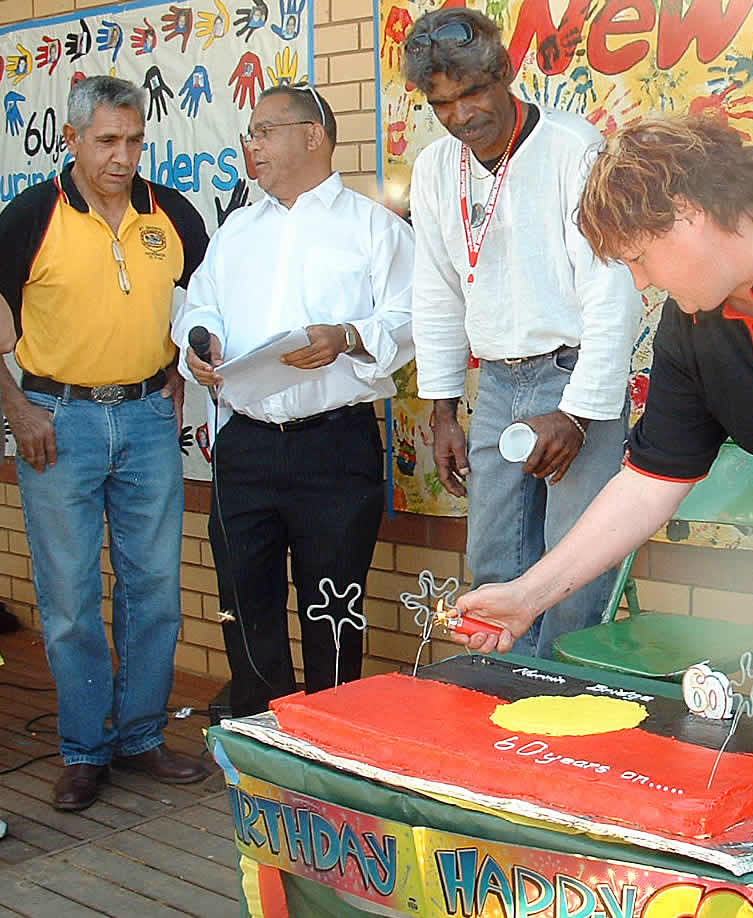
 It is well documented that traditional Aboriginal culture is based on a relationship with a specific area of land. The land itself is the source of spirituality, mythology, law, behavioural guidelines, justice, social order, identity and meaning. So when moved onto this reserve, the external forms of traditional practice dropped off sharply. The external rituals which gave people a sense of community and personal identity could not be performed as the Australian government adopted a policy of “assimilation”. It is well documented that traditional Aboriginal culture is based on a relationship with a specific area of land. The land itself is the source of spirituality, mythology, law, behavioural guidelines, justice, social order, identity and meaning. So when moved onto this reserve, the external forms of traditional practice dropped off sharply. The external rituals which gave people a sense of community and personal identity could not be performed as the Australian government adopted a policy of “assimilation”.
Then in 1978, ICA Australia received an invitation from the Murrin Bridge community to send staff to work with them. Prior to this, ICA staff had been working with Aboriginal communities at Mowanjum and Oombulgurri in north-west Australia.
A week-long planning consultation was held in March 1978 and from then till 1984 we had two to three ICA families living in Murrin Bridge. They worked with community members and the Coonchie Corporation to help them achieve their vision in areas such as education, health, and cottage industries. Mentoring of community leaders was an important part of this work.
Another key role was in challenging the racist attitudes of some of the people who provided professional services to the community, and facilitating cooperation based on respect for the people of Murrin Bridge.
When Wayne Nelson, the late ICA staffer, reflected on the time which he and his wife Jo had spent there, he concluded that the major contribution which ICA staff had made was in building bridges between the Murrin Bridge community and the wider community, both in the nearby town of Lake Cargelligo and beyond. On the surface initially it may have seemed that the people had “lost” their culture, but when given the chance it began to flourish again. Individuals, and the community as whole, regained their self-esteem and pride in being who they are, and this has been manifest in many different ways.
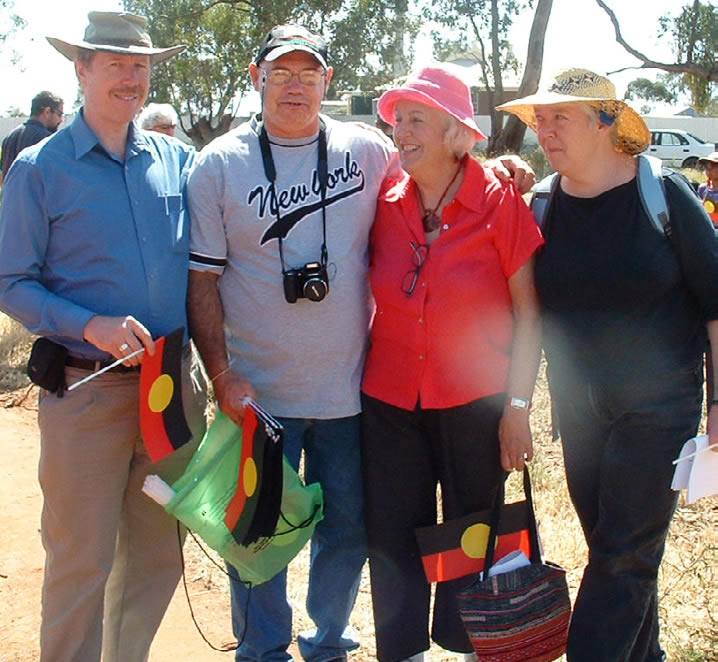
 Some young men saw an alternative to the wasted life style of some of the older men whose role in the community had been stolen from them in the “mission” days. Young men such as Craig Cromelin, mentored by Wayne. Craig was encouraged by the community Elders to take on the role of Chair of the Local Land Council when it was established soon after ICA staff had left. Some young men saw an alternative to the wasted life style of some of the older men whose role in the community had been stolen from them in the “mission” days. Young men such as Craig Cromelin, mentored by Wayne. Craig was encouraged by the community Elders to take on the role of Chair of the Local Land Council when it was established soon after ICA staff had left.
Shortly after this, the CDEP scheme was introduced. It provided incentives to encourage men and women to work in community projects. The Land Council won a contract to collect rubbish in the nearby town and as the men acquired more skills some found work in a local factory. Meanwhile, the women continued their sewing cottage industry and were employed in the Pre-school and Health clinic. Some of the Elders were invited to share cultural knowledge in the local schools. This created a new interest in learning among the children from Murrin Bridge. Artistic skills have also always been present among community members and the expression of this talent has been encouraged and shared beyond the community.
In the 1990s, the community established a new industry utilising their land to grow grapes. Working in partnership with a distillery nearby, they produced their own Murrin Bridge wine.
Reflecting on his experience, Wayne said: “We found that sustainable change in Murrin Bridge was, in many ways, more related to our communicating to the people that we believed in them and were willing to stand beside them as they made their own development efforts. For one who spent the years leading up to the assignment to Murrin Bridge in rather intense doing, this was a dramatic shift. Being there and loving the people was more important than anything we did. ‘You believed in us’ was a refrain that we heard several times.”
Craig’s passion to lead his people continues. He still lives in Murrin Bridge with his family and is currently the Chairperson of the NSW Aboriginal Land Council which represents Local Land Councils across the state of New South Wales. He has also represented the NSW Land Council at the UN Indigenous Peoples forum in New York and Geneva.
|