|
Path of the 4D Facilitator
By Jack Gilles
I arrived in Chicago from my home in Litibu, Mexico, with my wife, Judy. It was familiar territory: the airport, a taxi ride to the Uptown neighbourhood, then, what is now called the “GreenRise” building. It was the same journey that I had made years ago in the 20th Century.
But when I got to the 6th Floor to take part in the Global Archives Project as a “sojourner” my imagination went wild. The sight of photos of people whom I had so loved working with and reports and artifacts from places such as Mumbai and Maliwada village in India where I had 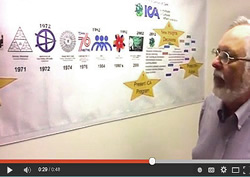 once worked triggered old memories, dreams and stories. once worked triggered old memories, dreams and stories.
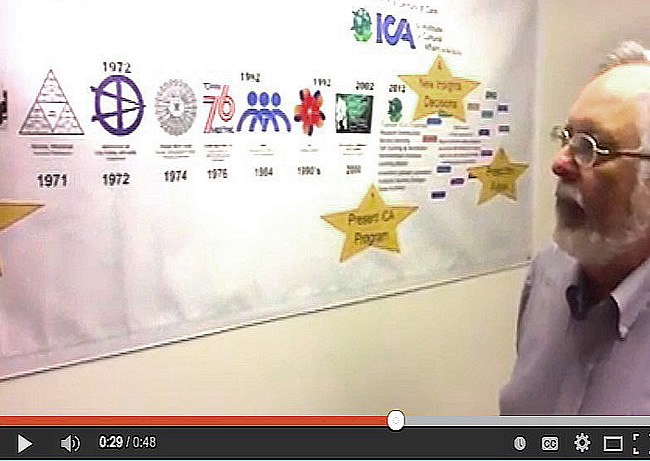
I viewed the iconic timeline of our work by archivist Paul Noah.
As I looked at all those images, I was back in the 20th Century, back from the future in a long-gone era. The words, audio recordings, musical notes and artifacts revealed the intricate, previously scattered and invisible pathways of ICA’s work. I was revisiting its design shop of ideas, walking on the “dreamtracks” that Bruce Chatwin describes in The Songlines, his book on Aboriginal mythology and the walkabout (read it here: https://miptnjupfirstyearstudents.wikispaces.com/file/view/Bruce+Chatwin+-+The+Songlines+(pdf).pdf).
In each era on the timeline, ICA’s work began as “dreamings” in research groups. Someone would then sketch a model and it became a design. Sometimes the dream track stopped there. At other times it developed into prototypes and mature programs like the 5th City Human development Project.
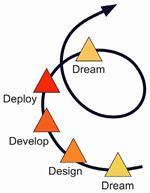
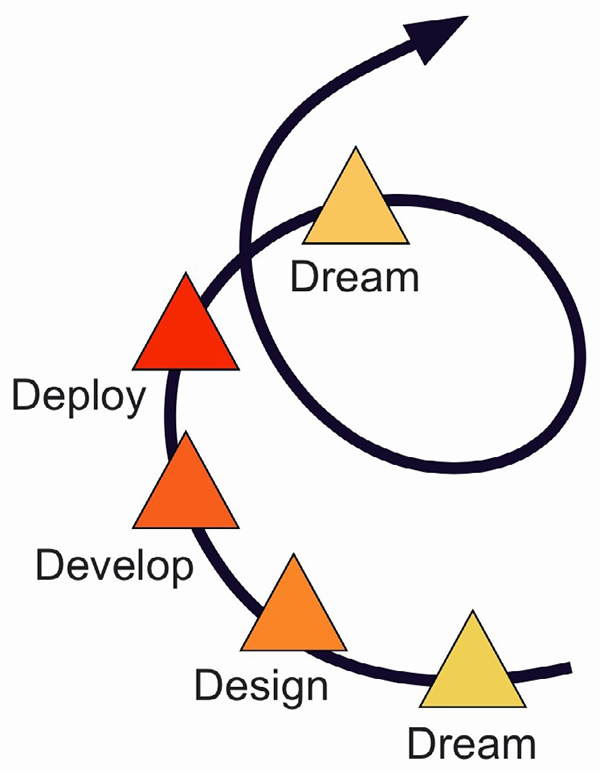
Paul’s diagram of this process is called “4D Innovation” dream, design, develop and deploy. That is followed by dreaming again in a new iteration. Someone who looked at the diagram (see illustration) asked: “What’s Dreaming” the rest are pretty familiar?” I said: “Dreaming is where human imagination comes in; Dreaming seems to be the answer to the question “Just what do you think you are doing?”
Developing LENS seminars
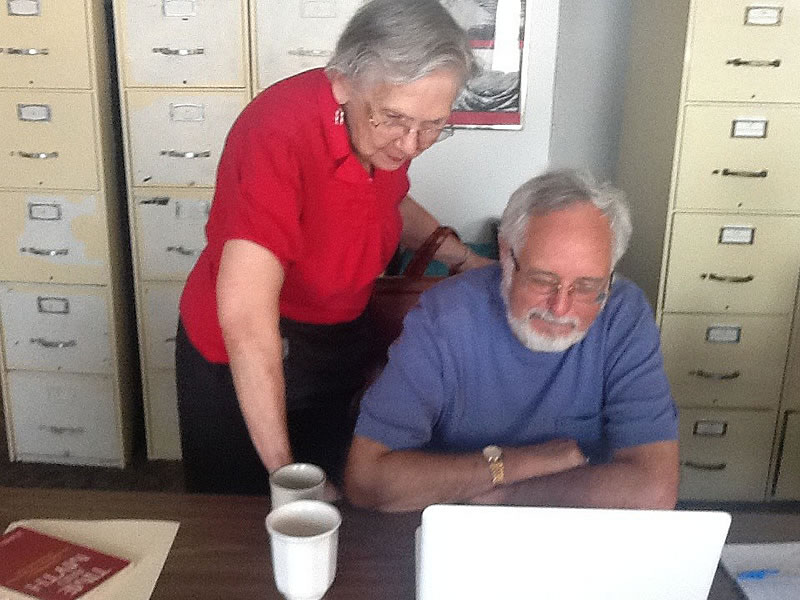
As I browsed on my computer, Marge Philbrook, the ArchivistInChief, poked 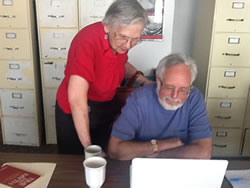 me in the ribs and said: “Jack, snap out of it, stop reading and reminiscing!”, “We’ve got to organize stuff, not get lost reading it. We got to get to work here finding and organizing the best of these materials so 21st Century people can use this stuff. Where do you want to go to work?” me in the ribs and said: “Jack, snap out of it, stop reading and reminiscing!”, “We’ve got to organize stuff, not get lost reading it. We got to get to work here finding and organizing the best of these materials so 21st Century people can use this stuff. Where do you want to go to work?”
LENS, I said, referring to the Leadership Effectiveness & New Strategies, an early seminar that led to the development of facilitation methods and facilitation communities of practice.
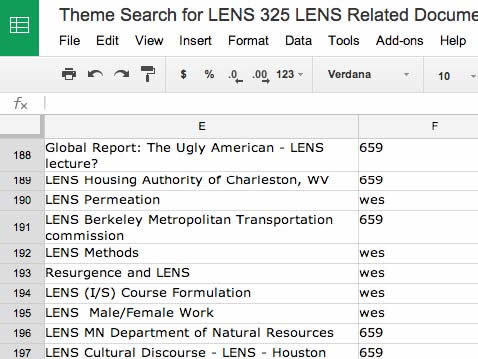
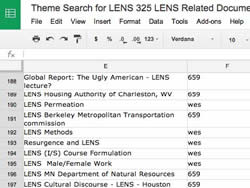 I got busy. First, I did a keyword search for LENS in the Archives database. Then, I walked over to the filing cabinets and found some documents. Some had already been scanned and I could read them on my computer screen. Too much data – it was like trying to drink from a fire hose! I got busy. First, I did a keyword search for LENS in the Archives database. Then, I walked over to the filing cabinets and found some documents. Some had already been scanned and I could read them on my computer screen. Too much data – it was like trying to drink from a fire hose!
After a while, I began to see how ICA’s Innovation had progressed.
First, there were early “Dreamings” experimental courses like NINS (New Individual in the New Society). There were lectures and workshops on the role of the “new individual in a new society”, and a social philosophy for rebalancing the economic, political and cultural dynamics of our time. But there was not much on group facilitating. One design focused on the individual was called “Living Effectively in the “New Society”.
Dreaming. I was knee deep in the details of papers and diagrams! What is interesting about this old dreaming stuff in the Archives?
Why keep it? Today, we can see the many risks taken and the many
ventures that failed gloriously just so that people could learn from
experience. In the same way, resiliency has been built into ICA’s
innovation process with all that research done in the last century.
People then probably asked “What in the world are you all doing
with this LENS stuff”?
Designing. In 1973, a new LENS seminar emerged. It was a stable “think tank” aimed at people in specific organizations who could gather off-site after work. They focused on “Leadership Effectiveness” and figured out how to execute “New Strategies”. There was a LENS campaign in the Southeast Asia-Pacific area that resulted in many such seminars. One ICA model in these LENS events and there were many – was the Social Process diagram, which later led to the Organizational Process diagram. Local communities, organizations and companies used this to plot strategy and organizational change instead of an “org chart”.
After reading 325 papers and getting lost in LENS data, I was tired. I needed something different – not just documents but the stories that went with them.
Bene Brown says in a TED talk that stories are “data with a soul”. That was what I needed stories of LENS seminars. I needed to find them, write them and tell them.
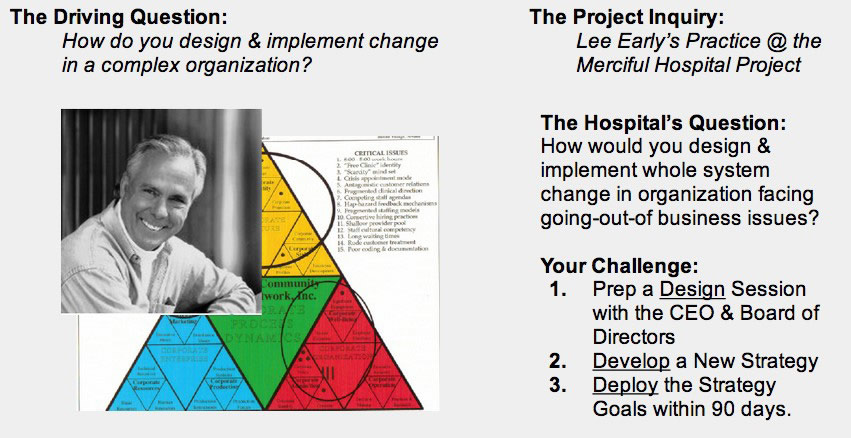
I found them in a video clip of an interview with an ICA veteran who had been a part of this campaign. We called him up and did an interview. We made a teaching model from his client case study of Merciful Hospital (not its real name) that raised a hard question: Given the facts, how do you not only design but also implement change in a complex organization like Merciful Hospital?
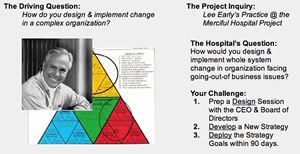 The triangle in the illustration is a “Corporation Process Model” blue is economic, red is political or organizational and yellow is the cultural process dynamics of organizations. The Merciful Hospital Board used it to focus strategic actions that were then implemented with help from a consultant coach. The triangle in the illustration is a “Corporation Process Model” blue is economic, red is political or organizational and yellow is the cultural process dynamics of organizations. The Merciful Hospital Board used it to focus strategic actions that were then implemented with help from a consultant coach.
This would be an interesting case for an online “project based inquiry” by people interested in responding to questions such as designing and implementing change in organizations.
Deployment. This is about making things happen, implementing and going to scale, not just doing one-off events. It is about changing the direction of things, not rearranging the deck chairs on a sinking ship.
I looked through files and read books in the Archives written by ICA colleagues to find a simple illustration that would show how LENS-style facilitation was deployed. I found one of the original LENS seminars done with US state-government agencies. I looked at the VisionContradictionStrategy charts produced in the seminar. I was surprised to discover I was one of the facilitators at this event with the Minnesota Department of Highways. I also found some interview notes of people who know about deployment – Mirja Hanson and Sue Laxdal.
Mirja did many LENS seminars during the administration of one Minnesota governor who was interesting in making state agencies really work for the people. She and Sue wrote about this in Government Works, a book edited by Jim Troxel and available at Amazon. Their chapter is titled Building the Habit of Transformation in the State of Minnesota.
We would like to sponsor a new version or update of this example of Deployment and see what new dreaming might occur. Both Mirja and Sue helped to inspire and sustain the ToP (Technology of Participation community of practice) with their own dreams, and innovations.
Facilitating in the 21st Century
One last point: What does it mean to be a facilitator and to facilitate in the 21st Century? This is a good question for communities of practice like the ToP network, the International Association of Facilitators and the Facilitators Network on LinkedIn.
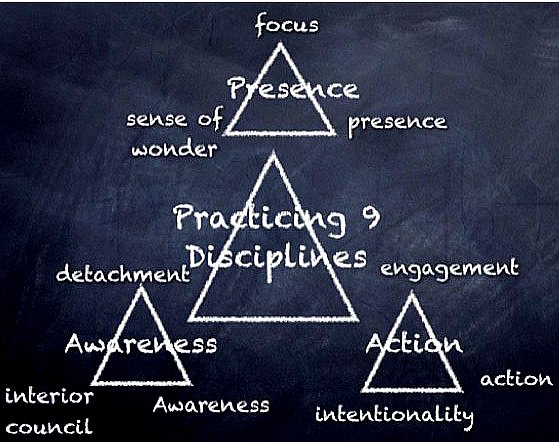
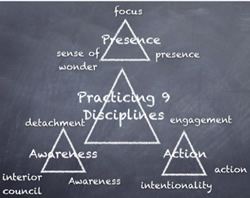 Where would you begin dreaming? What would the first sketch or image look like? Using categories from the Nine Disciplines of the Facilitator, a book by Jon and Maureen Jenkins, a sketch on an old fashioned blackboard might look like this. Where would you begin dreaming? What would the first sketch or image look like? Using categories from the Nine Disciplines of the Facilitator, a book by Jon and Maureen Jenkins, a sketch on an old fashioned blackboard might look like this.
The role of a facilitator might be that of a navigator. Facilitation procedures might be more like conversations and stories to help people navigate and focus on the following:
• Knowing: create and share awareness of data in stories with soul
• Being: invite people to be present, to say where they stand and what they stand for
• Doing: engage in project-based inquiry and execution that lay down new dreamtracks that make something good happen in our time
When all three are integrated, you have integrity the kind of Integrity that ICA founder Joe Matthews talked about seeing in the  Maliwada Human Development project. People become their own navigators whether in a village, a government agency or as the CEO of a large corporation. Maliwada Human Development project. People become their own navigators whether in a village, a government agency or as the CEO of a large corporation.
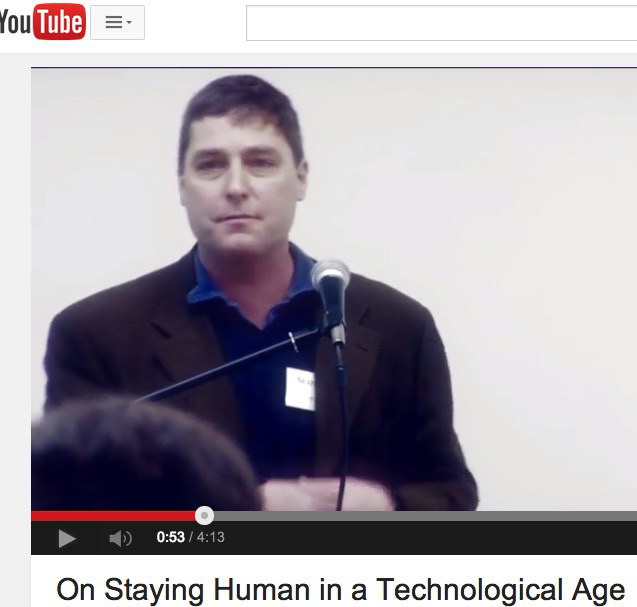
This is what Harvard philosopher Sean Kelly calls for in his talk Staying Human in a Technological Age (go to https://www.youtube.com/watch?v=8g8ue3dYpN0 to view this three-minute clip).
|