Putting ICA assets on-line
By V. Dharmalingam
Progress is seldom a linear succession of small and big victories. It is a meandering path dotted with fruitful failures and accomplishments, backtracks, dead-ends and surprises. This is especially true with human and community development and social innovation.
This is also apparent with the Institute of Cultural Affairs and the various projects, communities, and organizations it has worked with. A review of their journey has lessons for all those involved in similar work.
The Global Archives Project (GAP) aims to make available to the world the records of ICA’s work and the methods and tools it has designed. It is now gathering and organizing the related documents and artifacts.
 There is a trail of papers, videos, audios and photos scattered around ICA offices and in the file cabinets of colleagues and associates. The largest single repository is in the ICA USA Greenrise building in Chicago – 800 filing cabinet drawers in the basement and in four rooms on the 6th floor. About 20,000 individual items have been indexed in a searchable database. About 2,000 of these are currently available online. There is a trail of papers, videos, audios and photos scattered around ICA offices and in the file cabinets of colleagues and associates. The largest single repository is in the ICA USA Greenrise building in Chicago – 800 filing cabinet drawers in the basement and in four rooms on the 6th floor. About 20,000 individual items have been indexed in a searchable database. About 2,000 of these are currently available online.
GAP is run by a team in Greenrise – Sally Fenton, Jean Long, Marge Philbrook and Fara Taylor – and an online network of collaborators – Jack Gilles, Beret Griffith, Gordon Harper, Steve Harrington, Frank Knutson, Paul Noah, Tim Wegner and James Wiegel. Several others are working on specific projects.
Logistical challenge
Early work on the Archives began in the 1990s. They involved Lyn Mathews Edwards, David McClesky and Phil (LE) Philbrook, all now deceased, Marge Philbrook, Betty Pesek, Audrey Ayres and others. Their initial focus was on “Joe’s files” – the writings of ICA’s founder Joseph Wesley Mathews. His brother, Bishop Jim Mathews, deputed archivist Mary Ann Pickard, who devised an archival numbering system. The founder’s files were later handed over to the Wesley Theological Seminary in Washington, D.C. by members of his family.
More files arrived over the years. Some came from Phoenix and Hong Kong where ICA’s offices had closed, and others from individual ICA members. A 60-page archival catalog, Resources for the Future, was produced in 1995. Philbrook and McClesky published a collection of significant documents on CD in 1996. The disc, named The Golden Pathways, through the Movement of the Spirit in the Twentieth Century, has roughly 1,000 documents listed in the alphabetical index, plus 3,000 images.
You can now find this content at wedgeblade.net. This website, created by Gordon Harper, Tim Wegner and Len Hockley, was launched in 2006 as a repository of continuing OE/EI/ICA conversations to provide access to the Golden Pathways materials and now to provide access to GAP materials as they emerge online.
Organizing, processing and indexing archive materials is a huge task. Documents are being scanned, digitized and stored on servers for availability at wedgeblade.net. Currently the GAP is working on making the Archives FileMaker index available on web browsers so ICA offices and individuals who have ICA materials can share them. The idea is to use Archive tools and methods to “do your own archiving”. The Archives intends to invite several mini-projects to test easy “how-tos” for ICA offices and individuals this September.
All this work is done by volunteers and a few paid consultants on a very small budget. Since the work is particular, volunteers with a long historical memory are particularly helpful in recognizing and organizing specific content. Volunteers are welcome.
Week-long “sojourns” are being held onsite in Chicago with online participation for others to put volunteers to work on specific tasks. Since 2011 there have been several such Archive Sojourns. The idea of creating online collections grew out of one of these events. You can see and tour the new GAP Collections here: http://wedgeblade.net/wordpress/
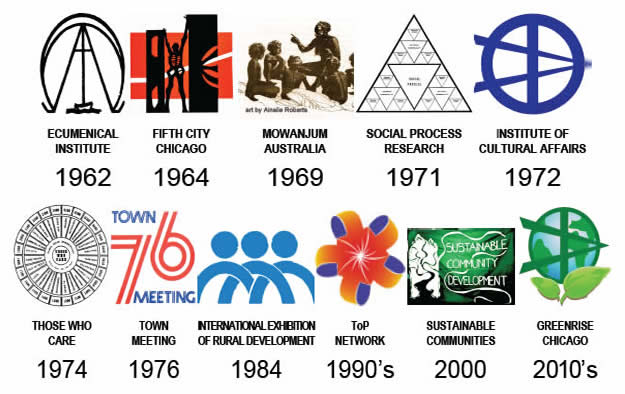
A symbolic review of ICA’s journey Paul Noah, an artist, is assembling a variety of symbols from previous ICA work – sometimes there are interesting stories that go with them. The following is a sample:
 1. Exploring, Living and Celebrating the Interior Life: Spirit Methods, the New Religious Mode, Spirit Conversations, the Other World, Profound Humanness, The Odyssey, Journey Constructs 1. Exploring, Living and Celebrating the Interior Life: Spirit Methods, the New Religious Mode, Spirit Conversations, the Other World, Profound Humanness, The Odyssey, Journey Constructs
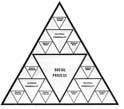
2. Analyzing How All Societies Work, Fail to Work and Can Be Changed: The New Social Vehicle, the Social Process, the Corporate Process, Pressure Points, Whistle Points

3. Building and Sustaining a Global Movement: The Symbolic Order, the Spirit Movement, corporate life, Religious Houses
4. Designing and Implementing a Strategy for the Renewal of the Church: The Local
Church Experiment
 5. Catalyzing Local Community Development on a Worldwide Scale: Fifth City Project, the Band of 24 Human Development Projects, Replication and Expansion Strategies and Projects 5. Catalyzing Local Community Development on a Worldwide Scale: Fifth City Project, the Band of 24 Human Development Projects, Replication and Expansion Strategies and Projects
 6. Demonstrating International Collaboration and Sharing: Sharing Approaches That Work and the International Exposition of Rural Development 6. Demonstrating International Collaboration and Sharing: Sharing Approaches That Work and the International Exposition of Rural Development
7. Introducing Transformational Strategic Thinking to Communities and Organizations: Global Community Forum, Town Meeting, LENS, Global Consults

8. Awakening Profound Selfhood: RS-1, ITI, the Academy

9. Developing Tools for Effective Collective Action: Facilitation Methods, the ToP Network
10. Creating Structures for Transformative Education: Imaginal Education, Intellectual Methods, Pedagogy, Charting, the Art Form, Seminar and Lecture Methods, the Minischool, Preschool, Student House, Rite of Passage Journeys, Training Inc., HDTI In the following pages, you can see some of the work done by GAP and read about plans for a Global Research Assembly in September.
This article by V. Dharmalingam is a pull together of material contributed by Beret Griffith, Steve Harrington, Marge Philbrook and James Wiegel.
|