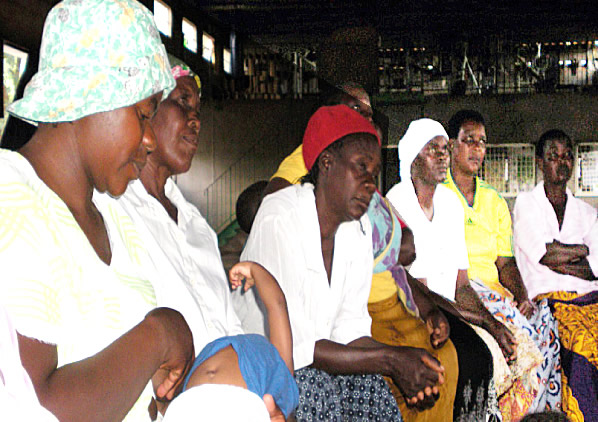
Helping communities fight HIV/AIDS
By Gerald Gomani
In January 2013, ICA Zimbabwe, in partnership with ICA USA, launched a project to implement HIV/AIDS campaigns in 50 communities over five years. The ZIM50 or Zimbabwe 50 Communities HIV/AIDS Project will demonstrate that communities can manage the HIV/AIDS challenge effectively with minimal outside assistance and resources. Four communities were chosen as pilot projects: Whitecliffe, Crowborough North, Churu Farm and Granary, all near Harare.
 African ICAs have worked on HIV/AIDS community prevention and management for a decade with ICA partners in the USA, Canada and UK. Projects have evolved, beginning with training peer educators to counsel their neighbours, community planning to mobilize people and learning to care for and help those affected by AIDS to manage their disease. As testing and treatment came on line, they became key components of an HIV/AIDS management program. Programs such as Living Well and Self-Help Groups were developed to provide social and economic support for those who need them. Stigma was addressed. African ICAs have worked on HIV/AIDS community prevention and management for a decade with ICA partners in the USA, Canada and UK. Projects have evolved, beginning with training peer educators to counsel their neighbours, community planning to mobilize people and learning to care for and help those affected by AIDS to manage their disease. As testing and treatment came on line, they became key components of an HIV/AIDS management program. Programs such as Living Well and Self-Help Groups were developed to provide social and economic support for those who need them. Stigma was addressed.
Over that time, knowledge about the disease and its transmission became better known. Government health services were able to cope with the flood of sick people and have answers for what to do to help them – starting them on anti-retroviral (ARV) therapy. As the international community began to support drug therapy at the national level and drugs became more accessible locally, people were able to work again, alleviating their despair.
But there are huge gaps. Too many are outside the fragile systems. For prevention and management to be effective, they have to be local. They must be a part of the community’s knowledge and culture base and of the social infrastructure. What is needed is a bold effort community by community to shift attitudes. Preventing and managing HIV is everybody's business – of each individual and of the community. ICA's efforts to assist communities in this have worked well over the past decade but the pace of getting communities engaged and competent is too slow to meet the challenge. Think of all the villages, neighbourhoods, and young people who struggle with the disease.
Communities need tools and methods to prevent and manage HIV themselves. Their efforts need to be sustainable and the project template replicable and adaptable. The Zimbabwe 50 Communities HIV/AIDS Project kicked off with year-long campaigns in the four pilot-project communities, getting leaders and villages to tackle this problem themselves. The role of ICA was to provide a tool kit and train people to use it. Residents did the work in the way appropriate for their community.
We know there are activities and capabilities that can prevent and manage HIV as well as other diseases such as TB and malaria. They include:
- Knowledge – trained peer educators are an invaluable asset in mobilizing awareness;
- Close association with local health and social services resources;
- Testing – it is available and essential for individuals to make a decision about behaviour;
Testing also identifies those who are infected and need treatment and support, and the families that need assistance;
- Living Well, Self-Help Groups and food security are useful programs for disease management and social and economic support.
For these programs to be sustainable within the community, the infrastructure must include determined community leaders and a well-trained core of volunteers  willing to spend the required time and energy. The basic attitudes and culture of individuals and the community must shift: It is our problem; we are responsible; we are the only ones who can make the changes necessary to manage this challenge. And we have to do it forever. Evaluating results leads to improved programs and infrastructure. The one-year campaign timeline adds urgency - to force the process. Among the first four selected communities, it has so far offered assistance and training to develop the knowledge base and implementation plans, change attitudes, create structures, and evaluate results to determine what is needed. ICA staff assistance will terminate at the end of one year although consultation will still be available. willing to spend the required time and energy. The basic attitudes and culture of individuals and the community must shift: It is our problem; we are responsible; we are the only ones who can make the changes necessary to manage this challenge. And we have to do it forever. Evaluating results leads to improved programs and infrastructure. The one-year campaign timeline adds urgency - to force the process. Among the first four selected communities, it has so far offered assistance and training to develop the knowledge base and implementation plans, change attitudes, create structures, and evaluate results to determine what is needed. ICA staff assistance will terminate at the end of one year although consultation will still be available.
The first year was a pilot. The results were encouraging. Communities selected their goals and key indicators of success. The evaluation in December showed the following achievements:
ZIM50 KEY INDICATORS OF SUCCESS
December, 2013 |
Communities |
Number of People Directly Involved in Community Interventions |
Prevention
Education |
Tested |
PLWA in treatment |
Living Well Groups |
Self-Help Groups |
Home -Based Care |
Nutrition
Education |
| Crowborough North |
720 |
98 |
38 |
80 |
60 |
48 |
|
| Churu Farms |
1500 |
298 |
80 |
84 |
80 |
18 |
750 |
| White Cliff |
2910 |
159 |
89 |
150 |
130 |
5 |
15 |
| Granary |
1000 |
85 |
45 |
120 |
60 |
20 |
|
| TOTAL |
6130 |
640 |
252 |
490 |
330 |
91 |
765 |
The campaign is under way in eight communities this year and will be followed by 12 in 2015- 2017. We hope to eventually have a prevention manual or tool kit that communities which wish to undertake a similar project can refer to and adapt. Staff training and consultation would be available to each new project.
From the perspective of ICA: Zimbabwe and its partner ICA: USA, we anticipate:
- 50 per cent reduction in incidence rate of new HIV infections
- 90 per cent of people infected and needing ARV therapy receiving treatment.
- Testing becoming the new rite of passage for all 16-year-olds.
- The number of mother-to-infant HIV transmissions dropping to zero.
- Every community involved says “This is our battle and we can do it”.
Some quotes from participants:
- “I have more knowledge about HIV/AIDS so as to help others particularly with nutrition.” – Tsungi
- “The training is effective and will transfer my knowledge to the community.” – Agnes
- “To have counselling skills.” – Eunice
- “To have knowledge to spread message about HIV/AIDS.” – Selina
- “I have new information about characteristics of community with HIV under control which I would apply in my own community.” – Sabina
We thank all those who have assisted in this project, particularly Louise Singleton, Robert True, Bruce Williams, Dick Alton and Seva Gandhi.
Zim50 is an Advance Special Project #3021526 of the United Methodist Church. If your congregation would like to support this project, please contact Dick Alton at richard.alton@gmail.com for more information.
Gerald Gomani is director of ICA: Zimbabwe
|