Using image shifts to change behaviour
By Jo Nelson
Self-image can be very strong. It has to be to protect us from knee-jerk reactions to every bit of information that comes our way. The strength which is important in a self-image can also make it difficult to change that self-image, even when it is creating unhelpful or self-destructive behaviour. When we understand the role of image in changing behaviour, we can understand and change our own behaviour and help influence others to change theirs.
Journey of Image Change
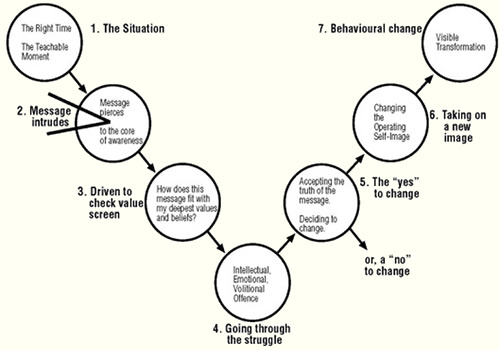
This model of the journey of image change has been empirically derived by shared reflection on the experiences of change among many people across the world. This journey can be described as having seven phases, each of which we pass through on the way to image change and therefore change in our behaviour. These phases are described in the seven circles in the visual model.
The following anecdote is about my experience of an image change. I grew up in a small rural community in the 1950s where very little changed, on a farm with my parents and grandparents, who loved me. It was a cocoon that kept me safe, so I had very little experience with great pain and disruption in my life.
Phase 1: When I was nearly 18, I went away to university, and encountered the broader world with a curious and open mind.
Phase 2: One night, a date took me to a movie, The Pawnbroker, about an old man, a holocaust survivor, in New York City who has flashbacks to the people he has lost and feels he had betrayed, causing their death. He mentors a young black worker in his shop. At the end of the movie, the young man is shot in the shop. The old man is so filled with pain that he impales his hand on a nail he uses to stick receipts on, to dull the internal pain. I was so shocked by this depiction of pain that I was speechless for several hours afterward. I had never imagined such pain in my life before.
Phase 3: During the next few days, I struggled with the thought of unbearable pain, and how it fit my values. That thought was a message that fit with my value of preserving life.
Phase 4: Then there was a series of internal arguments with the message. Intellectual: “It’s only a movie, it can’t be true!” Emotional: “It hurts too much to bear!” Volitional: “No! I won’t face this!”
Phase 5: Then I had a choice to make. Would I say yes to the change in image from the naïve “Life is comfortable” to the lucid “Life is painful”? After examining all the previous responses, I chose to accept the truth of the message.
Phase 6: The new operating image that I chose to operate out of was that life is not all roses, but that people experience real, unbearable pain.
Phase 7: The visible transformation in my behaviour was a major shift to working with compassion with my colleagues, students and clients.
In a single two-hour encounter, my images were forever shifted and my life changed. What is your story of image change?
Catalyzing An Image Shift
The next illustration is a tool that helps you think through how to address underlying images and change behaviour. Use it for yourself first. It can also be used in coaching or facilitating to help another person or a group to make a major change.
The following exercise gives step by step procedures, using the diagram in the illustration.
Consider your own routines and think of some unhelpful behaviour that you would like to change in yourself. Some outdated self-image may be the cause of that behaviour. If you can determine the self-image causing the unhelpful behaviour, then substitute a new image and messages to support it. In this way, you can self-consciously shift the self-image and the behaviour.
An Image Shift Exercise
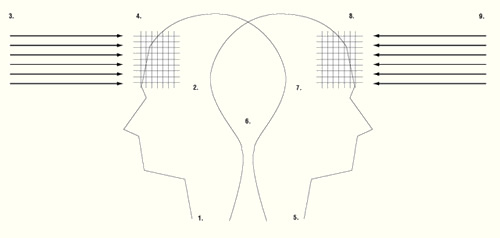
Use the two heads in the illustration, or draw your own.
1. Focus on yourself and your present behaviour. Think of a present behaviour that you are not pleased with; that is, behaviour that frustrates or compromises your vision of what you want to be. Choose a behaviour(s) and write it (them) on the line at the bottom left.
2. Draw a circle inside the head on the left. In the circle describe the internal or self IMAGE responsible for that behaviour. (examples: “controller”, “just a new-comer”, “judge”, “clown”, “victim”).
3. Think of the messages that you have received or are receiving that have created this image. Write those messages on the arrows pointing into the IMAGE.
4. Now consider the set of values locking that blocking IMAGE into place and protecting it. Name those values (examples: wanting to be well-liked, wanting to be successful). Place those values on the "screen" that protects the blocking IMAGE.
5. Now think of the new behaviour that you would like to adopt to replace the unhelpful behaviour. Describe that behaviour in a short phrase on the line at the bottom right of the head on the right.
6. Now think of THREE positive qualities that others say you have that can help you shift the IMAGE that is limiting you. Write each of these qualities in the “shared space” of the two heads.
7. Decide on a releasing IMAGE that can generate behaviour that will move you toward your vision. Draw a circle inside the head on the right. Describe the IMAGE in the circle.
8. Name the values that will hold that IMAGE in place. Draw a screen over the image and write the values on that screen.
9. Now decide on messages that you can “beam” to yourself that will support those values and create the releasing IMAGE. Think of visual, auditory, and kinesthetic ways of doing this. Write these ideas on each of the arrows on the right.
How will you ensure that you are continually exposed to the new messages?
Jo Nelson works with ICA Associates Inc, Canada
jnelson@ica-associates.ca |