Secret method that became a life changing program
By Ana Mari Urrutia
When I first encountered ICA’s participatory methods in 1975, I was going through the uncertainties of starting a large program financed by the “Telethon” fundraising campaign for children with disabilities.
As I learnt about the Technologies of Participation (ToP), my curiosity was sparked. I began using them at the Children’s Rehabilitation Institute without telling anyone else about it.
I used the Focused Conversation method at meetings, and found that it allowed us to reach decisions in one hour, shortening the sessions. When we needed a consensus, I would conduct workshops and make listings in columns to facilitate the process.
I realized that these methods were great tools to stimulate the creativity of the participants, to engage them and to allow them to own the projects they were part of. This meant that projects would not arise solely on the director’s ideas but with the input of all those involved. They bore magical results: they worked virtually on their own, fuelled by the group’s enthusiasm, motivation and commitment. I kept this secret to myself until my retirement.
I discovered that communication improves and becomes innovative and creative in the process of sharing ideas directly with others; that participation informs people’s opinions and enables them to view their future with a degree of certainty, allowing them to make plans in a realistic manner.
This gave life to various projects such as Literary Activities, Creative Painting for Youths and Children, Sports on Wheelchairs, Integrating the Family into Treatment and Transitioning into Treatment in the hospitals, and the School Extension Program.
All were designed by the professionals and ancillary personnel at the Children’s Rehabilitation Institute. I recall the pain we felt when one of the managing physicians decided that these were not rehabilitation activities, and ordered them to stop. Every single program went underground while he remained in office but reappeared as soon as he retired. Today, they are the most innovative and valued programs at the institute.
In 1995, we celebrated my retirement. What was said at that moment made me realize the enormous impact these methods had upon the spirit of my collaborators and upon our institution’s overall teamwork, especially in areas related to treating children and youths. It was an unforgettable experience.
True human development occurs in the company of fellow workers or our families as we build on our dreams and share our vision of life with respect, understanding, tolerance and solidarity.
In 1995, Eduardo Christensen and I went to the United States for training on the updated Technologies of Participation in Phoenix, Arizona. Upon our return after two months, we decided to teach these methods to others. We held courses for 900 primary and secondary school teachers; we also taught these methods to some of our friends to confirm that they could work in Chile.
With the support of the late Professor Nigel Blackburn, a great friend, we created a curriculum for the disabled. We were motivated by a patient, Carlos Kaiser, who owned a translation business and did everything at his office by himself. The first Program for Participatory Leadership (PELP) was offered at the Rehabilitation Institute in Santiago.
The course helps youth with physical disabilities make the transition from medical rehabilitation into becoming active members of society. It focuses on strengthening their self-esteem and developing their leadership and teamwork skills, while allowing them to design and implement their own projects in order to improve their lives and better their communities.
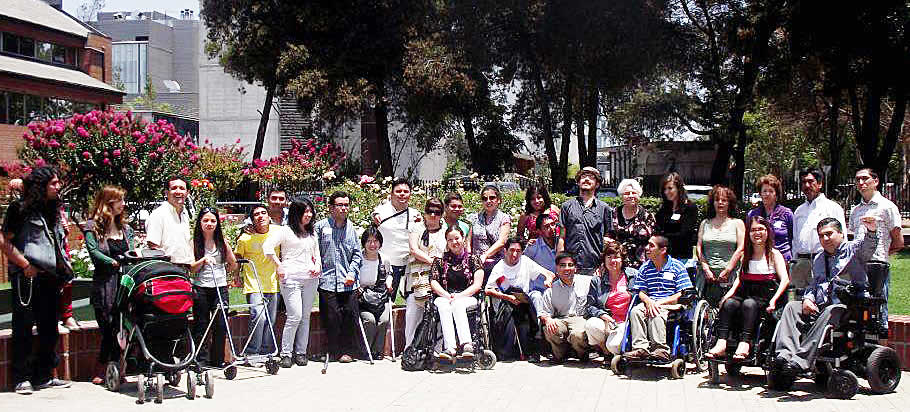
The “Telethon” became interested in implementing the PELP more broadly. The first course, for mainly physically challenged university students and 12 able-bodied students, was held in 2001. The 120-hour program was a roaring success. The participants continued their studies and today all hold good jobs. Some have changed their career paths, others got married. All in all, this course and the 20 others that followed have had positive results.
Ana Mari Urrutia is a staff member of ICA Chile
|