|
The Triangles Make Waves
Click triangles below to enlarge
By John Epps
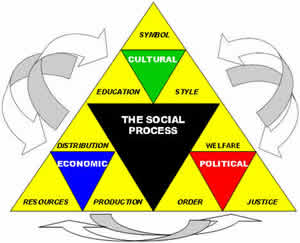
The ICA’s Social Process and Corporate Process Models, often called triangles, are making waves in the academic world. They provide the basis for graduate management courses offered on-line thorough the University of Maryland University College, where I’ve been teaching for more than a decade. Many students of the online courses are scattered around the world and are finding the models provide a new perspective.
When the ICA colleagues and staff developed the triangles in 1971-1972, we understood them to be tools for identifying ways of effectively catalyzing social change. Today they’re having a wider application than we imagined. They’re becoming a standard tool for businesses intending to operate globally. Graduate students in management studies are finding them indispensible.
 One course, “Managing Country Risk,” requires teams of students to identify risks facing a domestic firm operating outside its “home” country, a common feature of today’s globalized business environment. They’re assigned to analyze both the company and the country to see where there are “fits” and “misfits” (risks). One course, “Managing Country Risk,” requires teams of students to identify risks facing a domestic firm operating outside its “home” country, a common feature of today’s globalized business environment. They’re assigned to analyze both the company and the country to see where there are “fits” and “misfits” (risks).
The triangles have proven to be an invaluable tool for accomplishing this task. As one student says:
The Social Process Triangle and the Corporate Process Triangle delineate the dynamics of any social unit by providing a framework for a diligent analysis of social problems and issues and to discern opportunities for change. In my opinion, the SPT and the CPT are vital tools for appraising the climate for business and for assessing the capability of organizations to respond to changing climates. Both topics offer management a useful tool for understanding the process of strategic management.

It’s not that there are no other business analysis tools: in fact there are many. But none has the comprehensive and relational nature of the Social and Corporate Process Triangles.
Clancy Mann, (Professor and Executive Director, Institute for Global Management, University of Maryland University College) more than anyone else, has done outstanding work in developing the triangles for use in profiling nations and corporations. His introduction to the Social Process Triangle in Bending History II: Social Reformulation Towards a New Social Vehicle, pp. 101-127, is an excellent explanation of the triangle and its use. He has further refined it to be used in profiling a country.
Clarence Mann, “Managing Country Risk” in Borderless Business: Managing the Far-Flung Enterprise (Wesport: Praeger Publishing, 2006) p. 177.
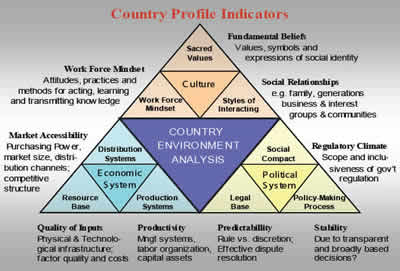
If the response of students (working adults) is any indication, this model has the potential of becoming a standard for global businesses. Other models focus on one or another of the processes, but none shows them all in their appropriate relations. And all too often companies overlook the cultural dynamics and the role they play in determining the response to an enterprise.
As other students commented,
“The Social Process Triangle (SPT) and its complementing Corporate Process Triangle are brilliant. What catches my attention about both graphics is the simplicity in which Dr. Mann is able to show to connectedness of the nine practical benchmarks for assessing a country’s business environment.”
“I find that the social process and corporate process triangles are excellent tools in doing a firm and country analysis. These models help to breakdown elements important for a firm to consider when making decisions.”
I’ve been teaching this course for 10 years now and have introduced more than 300 students to the triangles. Clancy has been at it even longer. We’re hoping this will help to provide a more comprehensive viewpoint to the leaders of business in the future.
How do we help these incredible tools to gain further acceptance and use?
ICA Canada has used them in working with clients and will be happy to provide further information. We have introduced them to the ToP® Network in the USA in a 6-session part-virtual course in 2011. ToP® facilitators who had little familiarity with ICA were pleased to find these tools as useful additions to their repertoire. The triangles are probably not useful for “teaching” to companies or organizations with whom we facilitate. But they are useful background materials and can serve as comprehensive checklists to organize reflections on trends, issues, and strategies. Meanwhile in academia, Clancy and I are promoting their use by the next generation of managers, and welcome your collaboration.

Background notes from the author….
the social process triangle in academia related to business. I'm using it as a major resource in a course leading to Masters of International Management degree through University of Maryland University College. I will include some student comments about it as well as an explanation of how it's being used.
I have and will send a couple of color graphic versions of the triangle, most done by Clancy Mann and used in his book Borderless Business: Managing the Far-flung Enterprise.
For more information, I can be reached at: jlepps@pc.jaring.my
Clancy's email is: clarence.mann@umuc.edu
John Epps, Adjunct Associate Professor, University of Maryland University College, Kuala Lumpur and Denver
|


