|
Success raises new challenges for ICA-Peru
By Ken Hamje
This year the ICA-Peru team is focused on creating demonstration communities of effective Community Self-Development (Auto-Desarrollo Comunitario) in 10 Regions all across the high Sierra of Peru. What does that look like? In about 100 communities there will be a new team of 5 -10 trained facilitators with practical experience and skills to guide the sustainable development of their communities. Mostly they will not be political or official leaders, but rather grassroots people who have been accepted by their communities as exemplars of effective family living. Wouldn’t you like to have a team like that in your community?
Click pictures to enlarge and for caption
Some people ask us “How did the ICA-Peru team get to this stage of service?”
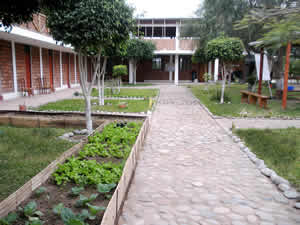
Since ICA entered Peru in 1979 its focus has been to preserve the vital and lively culture of the rural communities, especially in the high Sierra mountains where a third of the Peruvian population still lives. Over the years, the local staff has emerged as confident teachers and leaders, and the Training Center in Azpitia has become known as a place where lives were changed. But how do you take this practical experience and message across the Sierra where it is so crucially needed?
Originally we gained some basic support for our work through donations but new government regulations in the 1990s put an end to most forms of donations. Getting international grants became increasingly competitive and they were rarely attuned to our integral and self-led approach to community development. Then as the government pushed for corporate social responsibility funding by major corporations, it opened up a source to fund most of our work. Further, we discovered that when extractive industries entered a rural area, the disorientation they caused in the local culture was fertile ground for bringing about creative change for a new future for the families and their communities.
Now after six years of using corporate social responsibility funding, we are getting more demands for our services than we can handle – a place we never expected to be! While we are delighted with our new acceptance, we have to grow to meet the challenge while preserving the values of our ICA team culture. In this age of individualism, the expansion and formation of our service team is our challenge for 2013 – one calling for new creativity and collegiality.
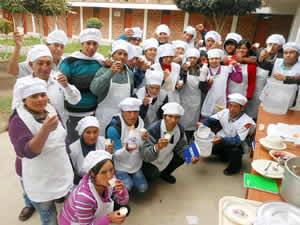 But how do you do staff formation when program demands have your people scattered to the four winds most of the time? Our teams of two, always made up of a man and a woman, go into the field for 10 – 12 days, usually working in extreme climates at around 4,000 metres altitude, mostly in isolation with only periodic access to a cell phone signal. The team must have a mix of skills as it coaches new local leaders in tasks ranging from presenting community forums, vision workshops and practical demonstrations; inoculating livestock; making yogurt; preparing organic fertilizer; to baking cakes with local grains. To be effective, team members need to be hearty self-starters. Often one member needs to know a native language like Quechua. And on top of this we need to prepare the teams with ICA methods skills and our style of team work and mutual respect. We do as much of this formation as possible around the collegium table, but we are now experimenting with 4 teams of 5 members each to provide more one-on-one training and support. But how do you do staff formation when program demands have your people scattered to the four winds most of the time? Our teams of two, always made up of a man and a woman, go into the field for 10 – 12 days, usually working in extreme climates at around 4,000 metres altitude, mostly in isolation with only periodic access to a cell phone signal. The team must have a mix of skills as it coaches new local leaders in tasks ranging from presenting community forums, vision workshops and practical demonstrations; inoculating livestock; making yogurt; preparing organic fertilizer; to baking cakes with local grains. To be effective, team members need to be hearty self-starters. Often one member needs to know a native language like Quechua. And on top of this we need to prepare the teams with ICA methods skills and our style of team work and mutual respect. We do as much of this formation as possible around the collegium table, but we are now experimenting with 4 teams of 5 members each to provide more one-on-one training and support.
Is it any wonder that we find ourselves challenged as we respond to the success that we created in attracting more clients? What a nice problem to have! We’re excited about where 2013 will take us!
Ken Hamje is a member of ICA Peru
|


