Timor Leste Forum for NGOs, learn Foundational Methods of ToP
By Karen Newkirk
Karen Newkirk is President, ICA Australia
Click all pictures to enlarge
|
On Wednesday the 21st of June David Jago and Karen Newkirk arrived in Timor Leste (TL) full of anxiety that the plan that had been generated to impart knowledge and skills to Timorese people would indeed succeed. For David it was his 8th trip to TL, my second and for Helen Ritchie (who joined us on Friday from New Zealand) it was also her second trip. Previous experiences had shown us how difficult it was to work in a multi-lingual situation without fully understanding the culture. The official language of TL is Portuguese, Tetan is widely used, Indonesian is widely used and many people have another local language. Different people have different levels of ability in each language with some not speaking any Portuguese others not speaking any Indonesian and others not speaking much Tetan. Some people speak English.
We had arranged to essentially deliver Module One of the Facilitative Leadership Program; the foundational methods of ToP i.e. Discussion Method and Workshop Method twice; once for the Co-facilitators and interpreter and then for the 26 participants.
Our local partner in the training was Forum ONG Timor Leste (FONGTIL). FONGTIL is the umbrella organisation for all local, national and international NGOs operating in Timor-Leste. Currently, there are over 450 member organisations across Timor-Leste’s 13 Districts. FONGTIL’s role, identified in the mandate from its members, is to facilitate the work of member organizations via information dissemination, coordination, advocacy and capacity-building.
Terms of Reference (TOR) were agreed including broad objectives that were, ‘Strengthen knowledge and skills for 13 district NGOs, 2 NGO Networks and 16 FONGTIL staff especially District Liaison Officers (DLOs) in their approach in communities through Technology of Participation (ToP™)’. The TOR also included a detailed outline of what would be done and anticipated outcomes.
Institute of Cultural Affairs Australia (ICAA) had raised over $6,600 for the purpose of delivering this training. Three ToP GIFL providers were willing to receive minimal payment to deliver the training and the US Embassy small grants provided about $1,000 for the training for FONGTIL staff and Members.
|
|
FONGTIL deeply appreciates the fund-raising and services provided by ICAA and ICAA deeply appreciates the fundraising and co-ordination by FONGTIL and particularly that of Elsa Pinto who enabled everything to happen and run extremely smoothly.
Support from FONGTIL included:
- Transport to and from airport, to and from FONGTIL during the training period. This was very good and much appreciated.
- Identification and booking of accommodation. Very central and comfortable accommodation.
- Training venue (FONGTIL meeting room and ‘classroom’).
- Identification of 3 co-facilitators and interpreter. All were excellent although the interpreter missed Thursday 21 June and one co-facilitator missed Friday morning causing initial understanding to be slightly less than it could have been. However by 5pm Friday 22nd June the training facilitators (David, Helen & Karen) were very excited about the level of understanding shown by the Co-facilitators and Interpreter. One co-facilitator (Elsa Pinto) had excellent English, a second had fairly good English and the third had a little bit of English however he was placed in the team with the Interpreter and he showed a very deep understanding of facilitative leadership (as did his colleagues).
- Lunches, morning and afternoon teas were provided and money was provided for meals that were external to the training for the training facilitators. FONGTIL also hosted a celebrative dinner on the Friday evening for the training team (‘PD CHECK’) and FONGTIL management.
- Printing of resource packs and Certificates were done at FONGTIL.
Co-facilitator / Interpreter Training
Training began on Thursday 21 June at 9am with an introduction to the foundational methods and the training program to the co-facilitators (the interpreter missed Thursday). A demonstration of the Discussion Method was followed by an exploration of what was involved and then a practice of the discussion method. The topic used was the quote from Alexandria Mikeljohn, “Democracy is the act of thinking independently together.” The three co-facilitators were excited and animated during the discussion and agreed that we use it for the conversation in the training on the Monday |
Monday 25 June
Transport was a little late on Monday resulting in arrival at the venue at 8.30am rather than 8am. A Training Plan (A) was presented for the week with movable post-it notes since we were very unsure how we would go getting the training across in the situation. For the same reasons we did not display Training Objectives except to say and illustrate that we were teaching the Discussion Method and the Workshop Method.
After the introduction including when the US Ambassador was arriving (11am) we began the conversation on the Alexandria Mikeljohn quote. Unfortunately it was not clear enough that this was the beginning demonstration and people became lost. A second mistake was made in not just accepting ‘liberty’ as an alternate word for ‘independently’. Fortunately we had a conversation prepared about the European football game that had recently taken place. This demonstration was very clear and had the animated participation (including those not interested in the football) required for such a demonstration.
The US Ambassador did arrive at 11am and speeches were made. The Ambassador responded to three questions taken from the group. This was a good participatory approach and did not detract from the training at all. We adjusted the timing accordingly.
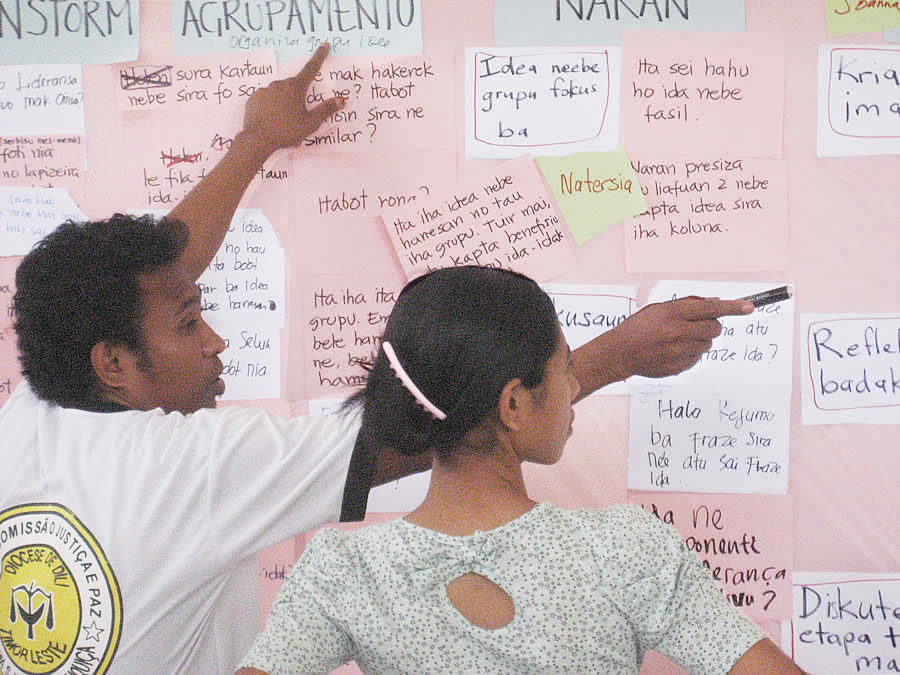
We broke into three groups in three spaces and prepared a discussion on the topic of ‘Discrimination in Timor Leste’ as this had been raised during the discussion on democracy.  Each space had a sticky wall and the teams named themselves; ‘Peace’, ‘Haburas’ / ‘Flourish’ and ‘Buka Hatene’ / ‘Search for knowledge’. The teams did not include the Facilitators and Co-facilitators and Interpreter as we formed a fourth ‘teaching team’ of seven people (‘PD CHECK’, the first name initial of each member). We rotated the groups through each of the spaces and facilitation teams so that over the week they formed a bond as a learning community and also had the opportunity to experience all three training styles. Each space had a sticky wall and the teams named themselves; ‘Peace’, ‘Haburas’ / ‘Flourish’ and ‘Buka Hatene’ / ‘Search for knowledge’. The teams did not include the Facilitators and Co-facilitators and Interpreter as we formed a fourth ‘teaching team’ of seven people (‘PD CHECK’, the first name initial of each member). We rotated the groups through each of the spaces and facilitation teams so that over the week they formed a bond as a learning community and also had the opportunity to experience all three training styles.
Tuesday, Wednesday & Thursday 26-28 June
Tuesday we practiced the Discussion Method in the three groups through, planning a discussion, leading a discussion and providing and receiving feedback on a discussion.
Wednesday a second practice of the Discussion
|
|
Method consolidated learning. The Workshop
Method was introduced with a demonstration and an exploration begun in each of the three groups.
Discussion Method topics:
- Democracy
- Czechoslovakia & Portugal Football Game
- Discrimination in Timor Leste
- Facilitative Leadership compared with three other styles of leadership (as per chart provided)
- NGO’s in Timor Leste
- End of course review (prepared on Wednesday for Friday)
Thursday we practiced the Consensus Workshop Method in the three groups through, planning a workshop, leading a workshop and providing and receiving feedback on the workshop.
Workshop Topics:
-
The benefits of Facilitative Leadership
-
The existing elements of Facilitative Leadership in Timor Leste
Twenty-five participants had the opportunity to practice the Discussion Method or the Workshop method and demonstrated varying levels of understanding of and skill in these methods. The 26th participant had no experience as a facilitator as he worked as an admin assistant in the office. He participated for the first three days but clearly struggled with the content and was not present on Thursday and Friday.
Elements of Facilitative Leadership were not foreign to the participants. Trainers noted great respect and collegiality between participants and assignments roles were done with gender balance in mind. It was useful to establish that significant elements of Facilitative Leadership were sprouting and securing roots in Timor Leste. Two of the older (late 30s/early 40s) participants stood up (separately) to deliver their practice Discussion forcefully delivering a lecture and not long into their delivery the other participants explained to them that they were not using the method that they were learning.
On one occasion during a workshop practice a participant said to the participant practicing, ‘Hey, you aren’t supposed to tell me what to think or where to group my response. You ask questions’. There was a great deal of laughter and admission that they hadn’t quite got it. One of them changed almost immediately stating that he now understood how to draw out the ideas from the group rather than telling them what to do. Many participants noted that in doing so they gained commitment to the outcomes.
|
Friday, 29 June
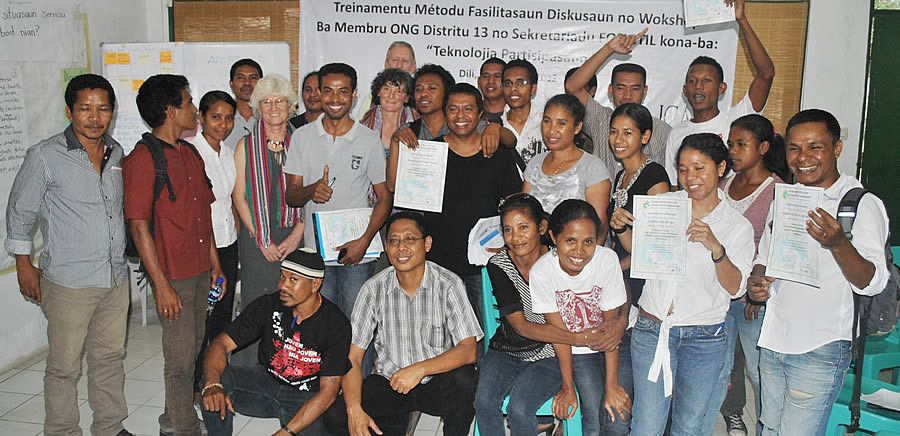
On the last day we covered the underlying dynamics common to both methods, had a discussion about application of the methods and then broke into work-groups determined by similarity of application. The work-groups  prepared discussions and then practiced on each other in three groups. This meant that all 25 participants had practiced a method twice by the end of the training (the 26th participant was not in attendance on the last 2 days). This concluded by 3.30pm in time for the scheduled afternoon tea. The evaluation and distribution of Certificates of Attendance was scheduled for 4pm till 5pm however there was some delay resulting in a five people having to leave before the evaluation. Twenty-four people including Caesar, Cornelio & Elsa completed evaluation forms. The closing was not finished until 5.45pm. prepared discussions and then practiced on each other in three groups. This meant that all 25 participants had practiced a method twice by the end of the training (the 26th participant was not in attendance on the last 2 days). This concluded by 3.30pm in time for the scheduled afternoon tea. The evaluation and distribution of Certificates of Attendance was scheduled for 4pm till 5pm however there was some delay resulting in a five people having to leave before the evaluation. Twenty-four people including Caesar, Cornelio & Elsa completed evaluation forms. The closing was not finished until 5.45pm.
Of the 26 participants 11 were from FONGTIL, 15 were from eleven NGOs. 13 were from districts outside Dili & 13 were from Dili. Feedback through surveys, a discussion and informally indicated that people learnt a great deal from the course and are keen to apply what they have learnt to their work.
Saturday 30 June
Helen left early for her plane back to New Zealand. The other two facilitators (David & Karen) and the Co-facilitators, (Elsa, Cornelio & Caesar) met from 2pm till 5pm. The agenda included:
- Confirmation of completion of the Terms of Reference for the work
- Team reflection on the training and the training journey of participants
- The training journey of the Co-facilitators
- Analysis of the Feedback forms
- Implications for monitoring and evaluation of application of training
- Future Training
The Co-facilitators expressed that they felt
|
|
excited and nourished by the experience of
being a Co-facilitator. None of them had done that before (all in their late twenties).
Comments regarding what the experience meant to them:
‘It changed my attitude and my way of dealing with people. Very interesting and helped me understand my attitude. I learnt not to push my own thinking’.
‘It helped me to gain knowledge. We have to be careful with interpretation as bad translation can really lead people astray. I can make use of these methods back in my district’.
‘It is important to not just use your brain in making decisions but to pay attention to what your heart and the hearts of others are feeling. I learnt how to do this in both the Discussion and Workshop methods. I have become stronger and more structured as a facilitator.’
Comments regarding decisions:
‘I would like more follow-up training. I would also like to see more of this training for NGOs and other organisations and government.’
‘Young people and leaders should get this training. I am planning to use these methods and to show others.’
‘Firstly I want to apply this to our monthly FONGTIL meetings. I want to learn more and complete all the modules. We will monitor and evaluate the use of these methods by the 26 participants.’
The Co-facilitators were able to explain things to participants during breaks as well as through appropriate interventions. This could be done because of the two-day training for the Co-facilitators. One participant, who clearly understood the methods by Thursday, was able to explain the methods to colleagues during
breaks. Participants learned from each other’s ideas and mistakes in small groups.
Participants felt engaged in their
learning.
Singing and a game lifted the energy after breaks and at the beginning of the day.
The training was a great success. The participants and co-facilitators delighted Helen, David and Karen with their demonstrations of the uptake of knowledge and skills in these valuable ToP methods.
|
|
|