Community Development was unheard of in the integrated communities of the 19th century where local needs were largely met with local creativity, and outside assistance was not expected. But the imbalances in communities created by the industrial revolution and the two world wars created many urban and rural communities with reduced initiative to care for themselves, inviting the emergence of a dependency that has led to today’s dominant images of community development as a process of delivering necessary services from “more capable”sources, often from the outside. Now as the 21st century has emerged, it has become clear that there is no bright future for
| |
 |
|
| |
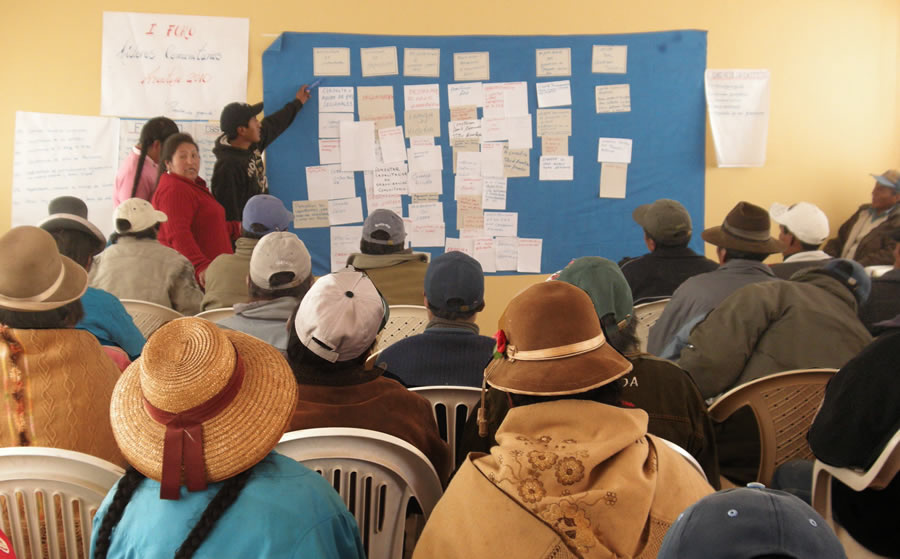
Local leader using ToP methods to lead a consensus-building community meeting.
Click to enlarge |
|
dependent communities, be they urban barrios, suburban bedroom communities or more isolated rural communities. Something radically new is being called for in communities of every continent, region and nation of the world.
In the early 1970’s the ICA built the Social Process Triangles which revealed the imbalances in society and the need for viable local communities as the new cradle of social evolution. As previously mentioned in this book, the freedom-giving ToP methods, tens of thousands of participatory Community Forums, and hundreds of demonstration communities were the ICA response towards building viable local communities. From this work and experience a more specific body of methods and practices has emerged which today can be characterized as Community Self-Development.
Typical Community Development Methods
The Community Development approach most widely practiced today is normally built upon a needs-based analysis by professionals from outside the community. Programs or projects are then developed to directly assist in responding to the documented needs, usually with limited input of the local citizens in the delivery process. This approach often leads to immediate improvements in the target needs, but at the same time initiates a dependency on the delivered services which becomes almost impossible to break, and in turn, leads to the demand for ever more intervention to meet ever more community needs. In a world of 7 billion people, this approach simply has no future in the 21st century where it is absolutely essential that ALL the citizens participate in the delivery of necessary services for their communities.
Local needs are typically defined by surveys and
analyses conducted by paid professionals from
outside of the communities.
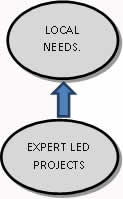
Projects are typically designed and delivered by outside experts to directly meet the needs which they have defined, usually with little community involvement.
The element that is missing in this needs-based approach is taking into account the persistent contradictions that are blocking the natural processes of meeting community needs.
Uniqueness of the ICA approach to Community Development
The ICA approach to community development, employing the ICA developed ToP methods, is dramatically different – in both content and in the style of application.
In the ICA process, the members of the community take the lead, with outside experts acting only as facilitators of the consensus which arises from the will of gathered local people:
- The community makes its own needs assessment – through the group process of defining their commonly held community vision,
- The gathered community then discerns the profound contradictions that are blocking their vision from coming into reality,
- Then the community defines strategic proposals which have the potential to totally eliminate the contradictions that are blocking them,
- And finally, the community makes commitments to implement these proposals at levels which they are currently prepared to support, in order to move themselves forward.
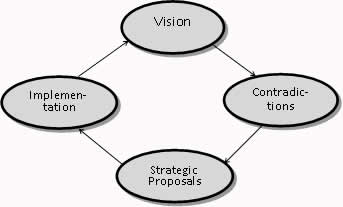
The key to this process is the definition of the Contradictions which, when defined, lead to an immediate breath of relief from the community, like lifting a huge invisible weight from their collective shoulders, for now it is clear to all exactly what needs to be done. For example, in Peru the nearly universal contradiction in communities is the rampant individualism which effectively blocks all forms of cooperation and collaboration. However, once the community ITSELF defines this reality it becomes clear to most of its people that it is essential to begin to work together to change their collective future. This paradigm shift brings clarity about what REALLY needs to be done and is the first step in getting new action taken.

Click above to enlarge
A Contradiction Chart is designed to show the Principal Contradiction in the center column,
with supporting themes to the left and the right.
Once this process of self-analysis and planning is in action, almost immediately a new vision begins to be born in the people, and soon they find themselves in a spiral process of growth in skills and consciousness as they successively, over months and years, go through the process of Community Self-Development.
We have lived and worked with this process in Peru for over 30 years and have seen hundreds of communities move themselves forward, sometimes quite dramatically and quickly. One of our most memorable experiences was working in Chincha after the 8.0
| |
 |
|
| |
Desperate people in Chincha self-organized to receive critically needed water barrels.
Click to enlarge |
|
earthquake in August 2007 where the majority of the people in the city of over 170,000 were homeless and without water or food. Our staff arrived after a few days with essential supplies donated by Japan and there were near riots as each family sought to take as much of the goods as possible. We decided to keep the truck closed up and announced to the crowds that we would return in one hour and distribute goods in their neighborhood, but only if they were ready to cooperate to meet the needs of their neighbors who most needed assistance. Leaders emerged from the crowds, lists were made, goods where distributed in an orderly manner, and there was a new style of cheerfulness and appreciation among the people. We returned to work in this city for over a year with continuing aid from Japan, and even in this extremely difficult situation the people operated with a high level of new-found cooperation and always defined their own needs and took the first action of organizing themselves and displaying initiative before receiving any outside assistance.
Integral Community Development for Sustainability
The focus on the elimination of the underlying contradictions in the community inevitably leads to an awareness of the need for Integral Development if the work in the community is to be sustainable. Tackling the tough challenges is the key to this approach, which takes a focus and seriousness rarely seen in normal sectorial approaches to community development. How can you expect a sustainable response to early childhood nutrition deficiencies if family incomes are not improved? How can new education initiatives be sustained if there are no jobs or needs for trained youth? How can you build sustainable communities when new transportation and communication infrastructure lead to an exodus of people and money from the communities? How can any sectorial project bring about sustainable integral development?
Human beings are integral by nature with all genetic, experiential, environmental and emotional influences creating a complex whole which needs to be nurtured at all levels at the same time. Experience has taught us that communities are equally complex and that community development can only be sustainable if it starts from an integral model, not from a hodge-podge of disconnected sectorial projects based on direct needs analysis and dependent on outside expertise and resources. In Peru this is very evident with the huge sectorial social responsibility investments made by the extractive industries which over the years have brought about fragmented dependent communities that systematically send their youth away to the cities for a doubtful future. In recent years, a few of these companies have moved toward an integral development model built upon the formation of teams of local leaders-facilitators who have a vision of making their communities truly viable and sustainable for the 21st Century.
Forming Leaders for Integral Community Development
Leaders of integral community development come in all shapes, sizes, ages and genders but they have at least one thing in common – they have undergone a paradigm shift which allows them to see all people in the community as resources, not as problems. To adopt a cellphone image, these people have undergone a change of “chip” – they simply see life differently. They know that everyone in the community has something of value to contribute and they have a hunger to know what it is and nothing will stop them from getting those contributions recognized by others.
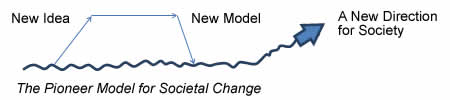
This new breed of volunteer community leader is what we call a “leader-facilitator” – ordinary people who use their skills of facilitation to elicit a new viable future from the citizens who they choose to serve. They share a common understanding that the only secure future for themselves and their families lies in being a contributing member of a cooperative community where collaboration is a way of life that nearly everyone embraces. They are the pioneers who bring about change through their persistent pursuit of the model of an integral community.
In Peru, each year we train about 300 of these leaders-facilitators to serve about 70 communities using an intensive 6-month leadership formation model for Community Self-Development. We can conduct 10 of these 6-month programs every year with a program staff of ten experienced facilitators, with each program being sponsored by a company to serve about 8-12 communities in their zone of operations. During the first month of the program, two ICA facilitators visit the communities and hold public meetings to orient the people to the program and its benefits, and to assist the communities in selecting their representatives to be trained as facilitators. In total we accept 30 representatives to go to the ICA Training Center in the community of Azpitia, which is the award-winning national demonstration of Community Self-Development started by the ICA in 1979. Here the 30 people spend three very intensive weeks of formation training in the methods and style of facilitation, including a wide range of practical hands-on experiences in agricultural technologies, productive businesses and effective personal and family living. At the end of these 21 days, the changes in these people are quite visible and the testimonials are remarkable.
During the four months following their Azpitia experience, two staff members work for 10 days each month to assist the new leaders to facilitate community meetings, training and demonstration of practical technologies which are immediately usable for the population with no outside assistance.This is Community Self-Development at its finest and the excited residents are invited to join the new leaders in Economic Networks to start new family businesses and increase their family incomes and wellbeing. This combination of enthusiasm and structure, with the support of savings circles for capital formation leads to about 50 new families businesses being initiated by the fourth month of the Implementation phase, putting the communities well on their way toward a new and sustainable future.
Quick Results in Canchan. In July 2010 we had 30 people from the mountain community of Canchan in our Training Center, and included were three candidates for mayor for the elections in October. During the first week, the three candidates were in constant conflict, each trying to outdo the other with loud and insulting comments, which moderated during the second week as they began to listen to each other. By the third week, the three were seen frequently working together with groups of other interested participants. We found out the following month that the group of 30 participants had decided that only one of the three candidates should run for mayor in order to pool their efforts to put an end to the years of tyranny of the incumbent mayor. In fact, their selected candidate won the election and the district has since moved in a new direction, much to the satisfaction of the citizens and to the amazement of the program sponsor.
|
The Lever for Sustainable Integral Community Development
After decades of experience with the freeing approach of Community Self-Development, we have learnt that a spark of self-interest is needed to build the momentum of the process to the level of being truly sustainable. We call this spark the lever which lifts the burden of initiating any new process that requires the collaboration of others, and for Community Self-Development that lever is the development of the Local Economy with productive family businesses.
The focus is on supplying the needs of the local economy, for that is where the people have hands-on experience and can know exactly where the market is and what it wants. We avoid programs which create products for outside (global) markets for these sales inevitably need to go through middle-men who have access to the markets and limit the income of the local producers. In addition, these global market sales are subject to great variability and style changes, whereas local economy markets tend to be much more stable with well-known cycles.
If done thoroughly, almost any Local Economy can be very stable and prosperous if it follows these four simple principles of operation:
- Transform local agricultural products for value added (make bread out of wheat)
- Replace products that come from urban factories or China (make school uniforms)
- Create new products and services needed locally (delivery meals for seniors)
- Buy locally made products and services (even if they cost a little more!)
Community Self-Development is Becoming the Future for us All
Incidentally, we will all come to understand that building the Local Economy is not an option in this century –much sooner than we think it will become a matter of survival for us all. As the price of energy climbs sharply – and it will – the “global markets” will dry up as
| |
 |
| |
Team work (at 13,400 feet) to prepare the activities for the Implementation phase of the community plan.
Click to enelarge |
people simply cannot afford to ship vegetables, grains and inexpensive factory goods around the world. LOCAL is the reality of the future, and we are now in the laboratory stage of polishing the models of how it can be done best, as there will be no “big brother” there to help us all when the need is urgent. There simply is not enough money in the world to hire people to replant the watersheds of the world, or even build adequate housing for 7 billion people. These basic tasks of survival have got to be done locally with the creativity and labor of the beneficiaries themselves.
Community Self-Development which engages people in their own care and development is emerging as the only viable future for rural communities in the 21st Century. And what other model can there be for urban communities as well? Already there are over 5,000 local economies in the world that have advanced to the level of having their own local currencies, and many tens of thousands more are in development stages.
LOCAL is the future that is already here. With a current global population of over 7 billion, the task of “community development” is far too large for any public or private institution to handle in any nation. There is no use waiting any longer for assistance – we have but to gather with our neighbors and get to work!
|