I was working with a group in China last year which thought the issue it was dealing with was structure. It was revealed through our dialogue that structure was a simple question but culture was where the real change was needed. Immediately insights began to flow and experiments were begun. What is the symbol of transformation in this situation? Scharmer says the key to change “prototypes” is developing options, then trying them out, knowing that none may be “it” but all lead to a new opportunity to learn.
Every action is a prototype
The context for action planning is transformed when it’s realized that the
result is often less important than other
factors: unintended consequences must
be attended to.
Let me use ICAI as an example. The ICA has a decision making structure called a general assembly (GA). It is made up of one representative from each ICA deliberating with colleagues from around the world to determine the directions and key decisions for our global structure and global community. In October 2010, members from ten national ICAs gathered in Talegaon, India, as the representative community to make decisions. It was experientially a low point of participation from the world and a high point of dialogue for those in attendance. This was the system we had used for 20 years but it was frustrating because it was so difficult to get everyone together, and to have enough time to talk and to share around the whole community. All the solutions seemed inadequate, too costly to gather and too difficult to get out all the opinions.
So we decided to let go of our old image of the GA – all together. We began to explore how ICAs might talk with one another regularly. We explored and evaluated where and how each ICA was operating. We explored virtual facilitation methods that were being developed. We invited “The Sisters”, a group of women facilitators who were experimenting with virtual facilitation, to share what they had been doing. In collaboration with them, we developed a form of dialogue combining regional dialogues with individual conversations to make sure all the ICAs were in on the conversation.
We tried a regional conversation, then another; if people missed the call, I would try to call them on Skype to make sure
they had access to the conversation.
It was messy, lasted too long and was
exhausting to the facilitators, yet for the
first time almost all of the ICAs had been
in the conversation, and heard each
other’s voices.
It was December and time for the GA.
We prepared everything - then the
system crashed the day before we were
scheduled to do the GA. That required
us to relook and simplify - and it worked.
It was not perfect by any means, but
another peer to peer, dialogue prototype.
Getting closer to truly having all the
voices heard, we held the GA with 80%
participation, through virtual input in
which all the ICAs participated.
The transformation is not over; we are
always changing from where we are, so
today begins a new prototype.
Larry Philbrook is President, ICA
International
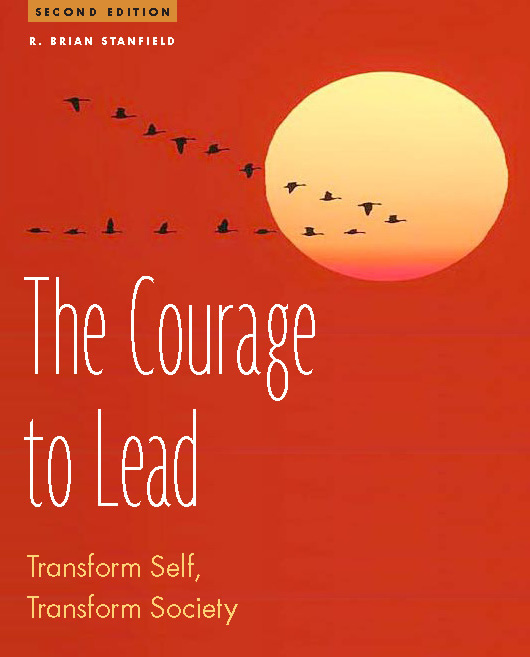
Book Launch for:
The Courage to Lead – 2nd Ed.
By Jeanette Stanfield
Kawalpreet Singh, a facilitator of studies of The Courage to Lead (CTL) said this about the first edition: |
|
The Courage to Lead has given me a sense of calm but rejuvenated my sense of internal revolution that I seemed to have lost in the rigors of daily life. In a more dramatic sense, I was like a Cheetah who would exhaust all energy chasing a mirage of a deer and then give up. Now I feel like a Duck, calm above the water level and to the world but continuing to paddle below the water level to win against the flow of adversities.
Maggie DiStasi exclaimed: I had defined leaders only as CEO’s and famous people who did great and public things with many followers. The idea of leading my own life in the way that I want and need to was life-changing.
These two people and many others like them have been sharing their experience of CTL and advising the editorial team about changes needed in the 2nd edition to clarify concepts and make them more accessible.
The 2nd edition is being published because of the learnings and passion of ICA facilitators who have designed and led studies and courses with CTL over the last 11 years. A memorial fund set up to Brian in ICA Canada has provided the funding needed to publish this edition.
I believe that Brian Stanfield would be very grateful to all of these people for their passion and care for the 2nd edition. The cover would surprise him. In specific chapters, he would notice structural changes we have made but I believe he would still recognize this book as his own. Brian’s voice and his personal stories have always been at the heart of CTL and he continues to play that role.
We have tried hard to decrease ICA jargon but I am sure you will still find some. Many recent stories are in the 2nd edition including stories about our earth and humanity’s role. With the help of John and Lynda Cock , we got permission to use a wonderful poem of Thomas Berry “To all the children” which is now published in his book, The Great Work.
To the children who swim beneath
The waves of the sea, to those who live in
The soils of the Earth, to the children of the flowers
In the meadows and the trees in the forest
To all those children who roam over the land
And the winged ones who fly with the winds,
To the human children too, that all the children
May go together into the future in the full
Diversity of their regional communities.
It has been a privilege over the last five years, for me to work with the editorial team of Daphne Field, Duncan Holmes, Staci Kentish, Fred Simons, Derek Stachan, and Virginia Varley on this 2nd edition. Kevin Balm, Mark Butz, John Epps, Jan Sanders, and Elaine Richmond were very helpful to my own thinking regarding this book. I also want to thank Ronnie Seagren and Brian Griffith for their editorial skills, Ilona Staples for her caring layout work and Bill Staples for working with the publisher.
ICA Canada looks forward to publishing the book in March 2012. We plan to have the book on Amazon shortly after that and in paperback and e-book formats. We would like to share CTL in some way at the ICAI conference and General Assembly in Nepal. The world is more ready for The Courage to Lead than it ever has been. This book is an ICA gem of foundational wisdom for all of our work around the world. May it become a friend.
Jeanette Stanfield is a member of ICA Canada.
|