During the 1970s, international consultants from the Institute of Cultural Affairs (ICA) and care-filled community leaders from Panvel, Maharashtra, India joined with the villagers in Chikhale to launch the Chikhale Cluster Human Development Project. This collaboration was envisioned as a sign of grassroots social change and became part of an international effort coordinated by ICA. The Chikhale Project called for a wide variety of economic improvements, resolutions to conflict among the classes and castes as well as training opportunities to allow the village to participate in contemporary social changes. In the earliest stages, plans were created to build a school which would equip students from villages to become leaders within their communities.
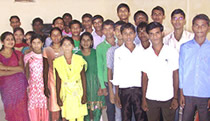
In 1989, Chikhale Ashram Shalla opened its doors to the first elementary grade level classes of tribal students from surrounding villages. By 2011, the school had grown to
| |
 |
| |
Click to enlarge |
serve 537 students, standards 1 through 12, in a residential environment where they can live, study and play together during the school year. Working in cooperation with the Government of India, ICA India and the Chikhale School administrative staff established both a science curriculum and a business and arts curriculum for the two upper grades. When the 5 boys in the 12th standard science curriculum take their final exams in March, they
Nelson Stover is a Past President of the Board of ICA International and is currently working as the Director of Educational Programs for greenschemes. For 38 years, he has worked on the staff of the ICA in various capacities and locations. At the request of ICA India, he is currently serving as an advisor to the Chikhale Ashram Shalla in order to establish a Global Classroom as a part of the Global Grassroots Education Project.
|
|
will become some of the first tribal students in their state to complete this level of course work. Their enthusiasm has encouraged 22 boys and girls to enroll in this year’s 11th standard science class.
Completing the building and learning environment for the Chikhale School has involved many groups and organizations over the past 30 years. Recently, major financial support for expanding the training center was
| |
 |
| |
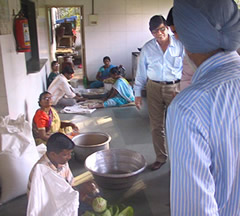
Donors visiting the kitchen where students’ meals are prepared, |
organized by ICA Japan. Several Lions Clubs in India also financed the furnishing of specific rooms within the building. In addition, business leaders from the area made substantial contributions including upgrading the school kitchen in which the students’ meals are prepared and providing sports equipment. A local bank donated computers for the school’s Global Classroom.
In December, 2011, eleven of the students of Chikhale Ashram Shalla initiated their Global Classroom by holding an internet conversation with their peers in the USA. In consultation with the Educational Division of greenschemes, the students in both schools wrote and exchanged papers focusing on their relationship to the natural world around their communities and schools. These papers provided a basis for the hour-long conversation among the students and laid the foundation for an on-going dialogue for the remainder of the school year. By including the natural world directly in their conversations, the tribal students were empowered to draw on their traditional wisdom while dealing with contemporary experiences. Thus, the students and faculty are getting equipped to include 21st Century technology and historic perspectives into their curriculum.
|


