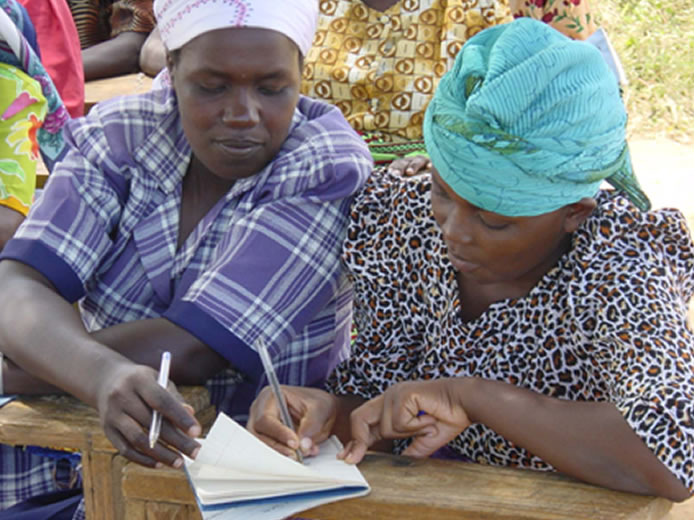
“We don't worry now when we need to start a project. After this training we noticed that communities’ participation in our programmes is increasing because they understand better what we do.”
2. In 2009, sponsoring staff members from ICAs in South Africa, Tanzania, Zimbabwe and OPAD (Zambia) to attend a major workshop on Resource Mobilisation in Zambia. Organised by OPAD and ICA:UK and attended by 23 people from 19 organisations in three networks and eleven countries (see photo above), the workshop developed a process for organisations to assess and develop their capacity to mobilise resources, a process that has since been tried and tested both in Africa and Asia.
3. In 2010, Village Volunteers supported the Safe Neighbourhood Foundation (SNF) in Budaka, Uganda, to hold a strategic planning process, bringing together 14 people from their staff, Board and key stakeholders for five days of deliberation and decision-making. As Vincent Namulezu, Chairman of the SNF Board of Directors, said,
“This Strategic Plan is a result of the input of a cross section of members of our community in Budaka, Board members of SNF, members of our civil leadership, all the management staff and representatives of farmers. The final plan, together with the budgetary proposals, contains all the essentials needed to strengthen SNF and Safe Neighbourhood Communities to plan for the future.”
One of the immediate benefits that SNF was able to gain as a result of having this strategic plan was the commitment of HorizonT3000, an Austrian NGO, to send an organisational development consultant to work with them over a period of two years to help them develop capacity in line with the plan they have developed.
4. 2011 saw two grants going to Kenya. After the success of the strategic planning event for SNF, a similar event was sponsored for Support
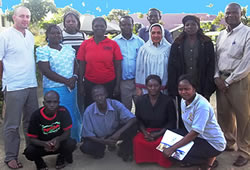 |
| Participants at the Support for Community Response Strategic Planning event in July 2011. |
for Community Response (SCR), a small NGO operating in the Coast Province set up by ex-ICA Kenya staff members. A second grant was given to SCR later in 2011 to host the first meeting of what is now called the East Africa ToP Network. It brought together ICAs from Kenya and Uganda (ICA Tanzania was unable to attend) and other East African NGOs with strong connections to ICA and its approach. This event has only just taken place (in November 2011), but the initial signs are that it marks the beginning of another example of how organisations can collaborate and work together for their mutual benefit.
Our experience with Village Volunteers has given us some key insights. Firstly, access to funding to enable investment in organisational development is a great advantage both for those organisations requiring such investments but also to those organisations seeking to provide support and advice.
For further information, see
www.ica-uk.org.uk/village-volunteers |
|
|
 |
| |
Click for enlargement |
One of the challenges of the more facilitative approach to organisational development is that it often places the burden of financing change onto the organisation which is least well placed to access such finance. Having Village Volunteers means that there can be some funding available at least to kick start the process of change and make some progress, even as longer term thinking, planning and fundraising are taking place.
In addition, such a fund has wider benefits. It provides evidence of a continuous and values-led approach to work with partners, which is significant in being able to attract funding from institutional donors. It also creates a further opportunity to recruit, engage with and retain a different supporter group. Although numbers have remained small, there is tremendous loyalty and the turnover of sponsors has been very low, even with the major shift described here.
Despite the clear advantages of such a scheme to development professionals, persuading individuals to support it is difficult. The scheme requires some understanding of how development works, an appreciation of the importance of local organisations in any development process and a readiness to give to a fund that is less likely to provide immediate and tangible returns on money spent. In trying to get these messages and this understanding across, we are, at least to some extent, working against the prevailing norms in fundraising, which are primarily to appeal to people’s emotions and emphasise the direct link between their money and a suffering individual’s welfare.
Looking forward, we believe strongly that this fund represents a sound approach that is vital to development and which leaves development firmly in the hands of the local organisation. We want to see Village Volunteers expand, engage more supporters and increase the level of funding available for our partners in Africa. We would also like to see our partners play a greater role in agreeing how the funds should be allocated and spent. Currently, such decisions are made in the UK (by the ICA:UK Trustees on advice from staff) in response to proposals received from partners. The ICA network in Africa has been talking of trying to establish a development fund for its own capacity development for many years, but this has yet to become a reality. Village Volunteers is already starting to fill that gap, but the possibilities exist for it to make a much more significant contribution, and for the ICAs in Africa to have a much greater say in its use and application. We welcome suggestions as to how to make that happen.
Jonathan Dudding, Director of International Programmes, ICA:UK
jdudding@ica-uk.org.uk |