Our work is in a cluster of four villages with a total population of about 5,000 in Mulshi Taluka, Pune District, Maharashtra state.
Our recent project, Poverty Reduction through Rural Development, has completed a successful three years. It is being conducted in partnership with JICA - Japan International Corporation Agency - and ICA Japan. The main objectives are: sustainable agriculture, dairy development, bio-gas plants construction (pilot project), agro forestry development, tree plantation and capacity building of beneficiaries and village leaders.
The project approach and methodology is participatory. Villagers are involved from the beginning in activities such as survey and planning. This makes the implementation process easy and effective and the cooperatives take ownership of the total project.
Sustainable agriculture: two cooperatives have been formed with 160 farmers who are running two irrigation schemes in two villages. Multiple crops such as rice, wheat, chickpeas, vegetables and fodder for animal feed are being grown on 160 acres under irrigation. An organic way of farming was introduced and several farmers have done this successfully. Many youth have stopped going to the city for jobs as the project provides sufficient employment opportunities and satisfaction.
Dairy development: A cooperative of 50 people is running the project; 32 of the families involved are supplying milk to the  dairy. A milk collection centre has been constructed with all the equipment required such as milk cooler, fat testing machine, lactometers and cans for milk collection. About 1,200 litres of milk is collected and sold in the city. A sales counter has been opened in the city. It sells milk products such as lassi, butter milk and curds. Families are purchasing more animals to increase the quantity of milk. dairy. A milk collection centre has been constructed with all the equipment required such as milk cooler, fat testing machine, lactometers and cans for milk collection. About 1,200 litres of milk is collected and sold in the city. A sales counter has been opened in the city. It sells milk products such as lassi, butter milk and curds. Families are purchasing more animals to increase the quantity of milk.
|
|
Bio-gas: During the last three years, 20 bio-gas units were constructed for 20 families in 4 villages as a pilot project. The women are happy with this project because it directly benefits them. They say it saves time, emits no smoke in the house, allows quick cooking and the slurry makes good fertilizer. A few homes have toilets attached to the bio-gas plants.
Tree plantation: We maintain a permanent plant nursery at our Environment Education Center at Talegaon Dabhade. Several varieties  of forest trees, fruit trees and medicinal plants are raised and distributed to farmers in our project area. An average of 15,000 plants are raised and planted each year. of forest trees, fruit trees and medicinal plants are raised and distributed to farmers in our project area. An average of 15,000 plants are raised and planted each year.
These four projects support each other. The dairy provides cow dung fertilizer for agriculture and bio gas; agriculture provides fodder for dairy animals; bio-gas slurry is used as fertilizer; and tree plantation provides fodder/feed as well as fruit and wood.
Women’s involvement: Women are encouraged to participate in training, meetings and in 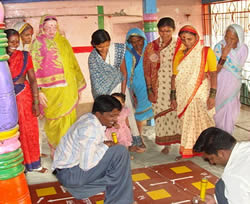 implementing projects. Initially their participation was low – two women for every 10 men involved. The number of women has now doubled and we hold separate meetings and training for them. implementing projects. Initially their participation was low – two women for every 10 men involved. The number of women has now doubled and we hold separate meetings and training for them.
Training: Both technical and capacity building training is held in villages and residentially at our training center in Talegaon Dabhade. Experts in relevant fields like agriculture, dairy, bio-gas and agroforestry were invited to take part. They included staff from the Pune Agriculture College and local government departments as well as a few private experts.
|


